
Mining Bitcoin on your PC or phone: the real numbers
Yes, technically: any computer or phone can do the calculation behind Bitcoin mining. But a CPU does it thousands of times slower than a small Bitaxe costing about €60, and even a high-end graphics card stays about 94 times behind, for 32 times the power. Here are the published figures, your real odds, what “mining” apps actually do, and what a PC is really good for when you mine at home.
Published 28 October 2026 · by Pixel · 11 min read
 5:13
Not usefully: an RTX 5090, a high-end 2025 graphics card, computes about 12.8 GH/s, 94 times less than a Bitaxe Gamma (rated at 1.2 TH/s). A CPU or a phone does thousands of times less. Solo, that card would have about 1 chance in 1.5 million per year of finding a block (network as of 17 October 2026).
Contents 9 parts and a FAQ · 11 min read
- Can you really mine Bitcoin with a computer?
- How much does a PC, a graphics card or a phone compute?
- Your odds and earnings, in numbers
- What about a graphics card or a Raspberry Pi?
- Phone mining apps: what they really do
- “Free mining” and “online mining”: the simple rule
- Fake mining software, a real danger for your PC
- What a PC is really useful for in mining
- What to buy instead
1. Can you really mine Bitcoin with a computer?
Technically, yes. Mining means computing hashes in a loop (SHA-256 The hash calculation Bitcoin uses, and so mining. Bitcoin Cash uses the same one: the same machines mine either. applied twice in a row to the block header), and any processor can do it: free software such as cpuminer mines Bitcoin on an ordinary CPU. In practice, the question has been settled since 2013: mining is done with ASICs A chip built for a single task. Bitcoin mining chips can only compute hashes, but extremely fast., chips that can only do this one calculation, but much faster and for far less energy.
Developers made it official. The cgminer mining software removed graphics card mining in November 2013 (version 3.8.0), and its documentation explains that CPUs and graphics cards, not efficient enough, have become irrelevant for Bitcoin mining. Then Bitcoin Core 0.13.0, Bitcoin’s reference software, removed its built-in miner in August 2016, because CPU mining had been useless for a long time, its release notes say.
I started in 2017 myself, with an RX 580 graphics card, to mine Ethereum: Bitcoin was already mined with ASICs. My “ASIC vs GPU” video (August 2024, in French) looks at the falling profitability of graphics cards and CPUs against home ASIC miners.
2. How much does a PC, a graphics card or a phone compute?
Everything compares in attempts per second, the hashrate Computing power: the number of attempts per second of a machine or of the whole network. The higher it is, the more tickets you play in each draw.. For each device, here is a published, dated figure: the historical table of the Bitcoin Wiki, recorded with real mining software, and measurements from hashcat, free hash A 64-character code computed from the block. Impossible to predict: you have to try.-computing software (it is used to recover passwords) that benchmarks double SHA-256, the very calculation of mining, on a shorter input.
| Device | Published figure | Mining attempts per second | Times slower than a Bitaxe | Odds of a block per year, solo |
|---|---|---|---|---|
| Bitaxe Gamma, BM1370 Bitmain's chip from the Antminer S21 Pro, also used in the Bitaxe Gamma and most recent desk miners. ASIC chip | 1.2 TH/s for 15 to 18 W, rated figures (my review) | 1.2 TH/s | reference | 1 in 16,000 |
| RTX 5090 graphics card (2025) | 12,785 MH/s of double SHA-256 (hashcat, February 2025), 575 W rated by Nvidia | 12.8 GH/s | 94 | 1 in 1.5 million |
| RTX 4090 graphics card (2022) | 9,985 MH/s of double SHA-256 (hashcat, October 2022) | 10 GH/s | 120 | 1 in 1.9 million |
| Threadripper 1950X CPU, 16 cores (2017) | 184.8 MH/s of single SHA-256 (hashcat forum, July 2022) | 92.4 MH/s | 13,000 | 1 in 210 million |
| Core i7 2600 CPU, 4 cores (2011) | 23.9 MH/s with cpuminer (Bitcoin Wiki) | 23.9 MH/s | 50,000 | 1 in 800 million |
| Phone, Snapdragon 865 chip (2020) | 21.3 MH/s of single SHA-256 (hashcat forum, August 2023) | 10.6 MH/s | 110,000 | 1 in 1.8 billion |
| Raspberry Pi Model B (2012) | 0.2 MH/s with cgminer (Bitcoin Wiki) | 0.2 MH/s | 6 million | 1 in 96 billion |
The cards in the table are top of the range: a more common card does less. A recent CPU is faster than that 2017 Threadripper, but even ten times faster, it would still be about 1,300 times behind a Bitaxe. The Bitaxe, for its part, is no farm machine: it is one of the smallest ASIC miners, made to sit on a desk. My first one, in 2023, already did 400 GH/s, over 30 times an RTX 5090.
3. Your odds and earnings, in numbers
Your odds are proportional to your share of the network’s hashrate, about 1,006 EH/s (network as of 17 October 2026). Assumptions: device running 24 hours a day all year, constant difficulty, electricity at €0.20 per kWh, pool A server that machines connect to. A regular pool shares the earnings, a solo pool does not. Solo or pool? earnings on average and before fees.
about 1 chance in 1.5 million per year of finding a blockabout €0.15 a year, for about €1,000 of electricity at 575 Wabout €0.0011 a yearabout 1 chance in 16,000 per yearabout €14 a year, for about €32 of electricity at 18 WA PC you already own does not mine for free either: if it draws 100 W more while mining, that is about €175 of electricity a year, for a few cents of earnings at best. The Bitaxe does not cover its electricity on average at French prices either: it is a lottery and a way to understand Bitcoin, not an investment (how much a Bitaxe earns). The solo mining calculator redoes these sums live for any machine.
4. What about a graphics card or a Raspberry Pi?
The graphics card. It mined Bitcoin until 2013, before ASICs made it useless: the Bitcoin Wiki keeps its table “for historical interest”. Today, an RTX 5090 uses about 45,000 J/TH The energy used for a trillion attempts: the lower, the more efficient the machine. A Bitaxe Gamma runs at about 15 J/TH. The comparison at its rated 575 W, against about 15 J/TH rated for a Bitaxe Gamma: watt for watt, the Bitaxe computes about 3,000 times more. Software that offers to “earn bitcoin” with your graphics card usually has it mine other cryptocurrencies, then pays you in bitcoin: that is not Bitcoin mining, and this guide stops there.
The Raspberry Pi. The first model (the Model B, pushed to 800 MHz) did 0.2 MH/s in 2012, 6 million times less than a Bitaxe. A recent model is faster, but it is still a small CPU, not a mining chip. Its real role lies elsewhere: according to Umbrel’s documentation, a Raspberry Pi 5 runs umbrelOS, and so your Bitcoin node and your own solo pool; Umbrel recommends booting it from an NVMe or USB drive rather than a microSD card.
5. Phone mining apps: what they really do
A phone has the same problem as a PC, only worse. In a test posted on the hashcat forum, the CPU of a Snapdragon 865, the chip of 2020 high-end phones, computes about 21 MH/s of single SHA-256, in a Linux environment running on the phone: about 10.6 MH/s for mining, 110,000 times less than a Bitaxe, or about 1 chance in 1.8 billion per year. Even ten times faster, a recent phone would still be about 11,000 times behind, while draining its battery and heating up.
On iPhone it is written in black and white: the App Store Review Guidelines forbid apps from mining on the device unless the processing happens elsewhere, such as cloud-based mining (guideline 3.1.5), and ask them not to drain the battery or generate excessive heat (guideline 2.4.2). On the App Store, a “mining” app therefore does not mine with your phone: at best it shows mining done elsewhere.
On Android, the apps that researchers took apart did not mine either. The same tricks keep coming back, which I describe here without naming any app:
- A counter that runs by itself. In 2021, Trend Micro analysed “cloud mining” apps: none of them mined, the mining on screen came from a counter and random draws computed on the phone.
- Ads. Watching videos to “start” or “speed up” mining, clicking on ads to “prove you are not a robot”.
- Referrals. Inviting friends to unlock withdrawals, which then stay “pending”.
- Purchases. Subscriptions of around $15 a month, “extra mining power” from $14.99 to $189.99. One of these apps stated in its terms of use that it was only a game, with no mining at all.
- The fake balance. Lookout found more than 170 “cloud mining” apps the same year, 25 of them on Google Play, with over 93,000 victims and over $350,000 collected by its estimates: no mining took place, and fake minimum balances pushed users to spend more.
Two tests suggested by Trend Micro: restart the phone while it is “mining”; if the balance drops back to zero, it was just a counter. And enter an invalid wallet address: if the app accepts it, be wary.
6. “Free mining” and “online mining”: the simple rule
Real mining always costs something: a machine and its electricity. One benchmark is enough to unmask most offers: on average, 1 TH/s earns about €0.033 a day, before electricity and fees (network as of 17 October 2026). A site that promises €1 a day with no machine is therefore claiming to give you the equivalent of about 31 TH/s, or 26 Bitaxe Gammas running for you at its own cost. If it asks for a deposit, referrals or a subscription, that is where the money comes from.
“Browser mining” is no better: a site that mines while you read it runs a script on your processor, for its own benefit, as Microsoft describes. Before putting money on an online mining platform, French readers can look its name up on the AMF blacklist (in French), which has a crypto-assets category. Cloud mining has its own guide: cloud mining, scam or real mining.
The honest alternatives are not free: buy a small machine (see below), or rent real ASIC hashrate for a few hours on MiningRigRentals, knowing that most rentals find nothing.
7. Fake mining software, a real danger for your PC
Searching for “bitcoin mining software” quickly leads to dubious downloads: bitcoin “generators”, “optimised” miners, “free” tools. It is a well-known hunting ground. Microsoft describes campaigns that install trojanized miners, putting victims’ computers to work for the attackers. In 2022, Cyble counted about fifty fake sites imitating MSI Afterburner, a legitimate graphics card tuning tool: the booby-trapped installer contained a data stealer, RedLine, and a hidden Monero miner that mined to the attackers’ wallet, pausing whenever certain programs were open.
- Only download from the project’s official page (its GitHub repository, for example), never from a link under a video or in a private message: Cyble reports such booby-trapped tools on YouTube and torrent sites.
- Steer clear of anything that promises free bitcoin. No software makes bitcoin without work: a “generator” is a trap.
- Keep an eye on your machine. A CPU or graphics card running flat out for no reason should alert you: Cyble advises checking system performance and CPU usage regularly.
- Never type your recovery phrase into mining software: a miner only needs a receiving address.
The same trap exists on the hardware side, with ESP32 “lottery miners” sold as a chance to win: how to spot them.
8. What a PC is really useful for in mining
Your computer will not mine, but it has a real role to play when you mine at home:
- Running your Bitcoin node. Bitcoin Core checks every block and every transaction itself, trusting nobody. Plan for an SSD of at least 1 TB and a first sync of several hours to several days.
- Hosting your own solo pool. With Umbrel, you install Bitcoin Node and then Public Pool, and your machines mine on your own infrastructure: install Umbrel on Windows.
- Monitoring and tuning your miners. The Bitaxe interface, AxeOS, opens in a browser, and an extension such as Bitaxe Viewer finds every Bitaxe on your local network. On findmyblock.xyz, the solo pool I built, your address shows each machine’s hashrate and your best share.
- Updating or repairing a miner. The Bitaxe software updates from the browser and can be reinstalled over USB with an online flasher: update AxeOS.
The node does not need a racing machine: the miner does the computing, not the node. A Raspberry Pi 5 is enough, as seen above.
9. What to buy instead
To really try your luck, you need an ASIC chip. The two cheapest ways in:
A NerdMiner with a real ASIC chip: perfect to learn, not to hope for a block. My review.
The miner I recommend to start with: open source, set up from a browser, about 94 times the hashrate of an RTX 5090 for 32 times less power. My full review.
To compare every machine by budget, noise and room: which miner to choose. To mine solo without installing anything, FindMyBlock, the pool I built, charges a 0% fee and the reward goes straight to your address. If you buy, my partner code for MineShop (partner link) is in Support.
And to keep your feet on the ground: with 13 machines and about 50 TH/s, I still have not found a block. A home miner is a lottery ticket and a way to understand Bitcoin, not an income.
Frequently asked questions
Can I mine Bitcoin with my PC?
Technically yes, free software such as cpuminer does it, but a CPU computes thousands of times slower than a Bitaxe. In a pool, a 16-core CPU would earn about €0.0011 a year on average (network as of 17 October 2026), far less than its electricity.
What software do I need to mine Bitcoin on a PC?
cpuminer, free software, can mine Bitcoin on a CPU, but with no realistic chance. Be wary of “mining software” downloaded outside official pages: it is a known way to install a data stealer or a hidden miner. On a PC, the useful software is a Bitcoin node, a pool such as Public Pool and your miners’ interface.
Can you mine Bitcoin with a graphics card?
Not usefully since 2013. An RTX 5090 does about 12.8 GH/s of double SHA-256, 94 times less than a Bitaxe Gamma, for 575 W rated: solo, about 1 chance in 1.5 million per year. To mine Bitcoin, you need an ASIC chip.
Are Bitcoin mining apps for phones legit?
On the App Store, they do not mine with your phone: Apple’s rules forbid it, except for mining done elsewhere. The Android apps analysed by Trend Micro and Lookout did not mine at all: the mining on screen was simulated, and the money came from ads, referrals and in-app purchases.
Can you mine Bitcoin for free or online?
No. Mining takes a machine and electricity; a “free” offer is paid for some other way: ads, referrals, a deposit, or your computer working for someone else. On average, 1 TH/s earns about €0.033 a day: a promise above that, with no machine, is not mining.
Sources
- Bitcoin Wiki, historical table of CPUs, graphics cards and ARM chips
- hashcat on the RTX 5090 (February 2025), including double SHA-256
- Nvidia, RTX 5090 specifications (575 W)
- Bitcoin Core 0.13.0 (2016), the built-in miner removed
- Apple, App Store Review Guidelines 2.4.2 and 3.1.5 (no on-device mining)
- Trend Micro (2021), fake mining apps
- Lookout (2021), over 170 cloud mining apps that never mined
- Cyble (2022), fake MSI Afterburner sites: data stealer and hidden miner
A question about this guide? Ask it on the Discord, several of us answer there.
Other guides
-
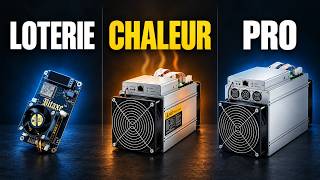 Getting started with Bitcoin mining at home
The principle, the machine, the cost, solo or pool, and the five steps to start.
3 min read · updated 17 Oct 2026 · new
-
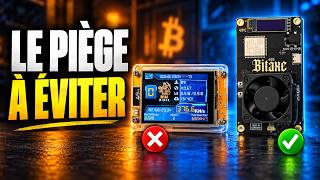 Fake Bitcoin miners: the ESP32 lottery miner trap
An ESP32 is not a mining chip: three questions so you never pay $50 for a device that would take 55 billion years to find a block.
5 min read · published 17 Oct 2026 · new
-
 Cloud mining: scam or real mining? The one-calculation test
One calculation tells you whether a cloud mining contract pays out of real mining.
13 min read · published 28 Oct 2026 · new
-
 Which miner for home mining?
Hashrate, electricity, noise: the criteria that really matter.
2 min read · published 23 Sept 2026