
Fake Bitcoin miners: the ESP32 lottery miner trap
This little gadget is sold as a Bitcoin miner, a shot at finding a block through “lottery mining”, for a few dozen dollars. I did the math: on average it would need 55 billion years to find a block, about 4 times the age of the universe. Here is how to spot these fake miners in a few seconds, so you never get caught out.
Published 17 October 2026 · by Pixel · 5 min read
 5:45
Contents 8 parts and a FAQ · 5 min read
1. Solo mining is a lottery
Mining solo is buying lottery tickets. Every calculation your machine makes, a hash A 64-character code computed from the block. Impossible to predict: you have to try., is a ticket. The whole Bitcoin network draws about 1,006 billion billion of them every second (1,006 EH/s, network as of 17 October 2026).
Your odds depend on one thing only: how many tickets you draw per second, your hashrate Computing power: the number of attempts per second of a machine or of the whole network. The higher it is, the more tickets you play in each draw.. Not the design, not the screen, not the colour of the case. And that is where the trap hides: between a kH/s and a TH/s there is not a small difference, there is a factor of a billion.
2. The Gold Nugget: an ESP32, not an ASIC
Take the example from the video, the Gold Nugget: sold for around $40 to $50, rated at about 350 kH/s. Inside there is no mining chip, but an ESP32 A microcontroller worth a few euros, the kind in smart plugs. It can compute SHA-256, but millions of times slower than an ASIC chip: an ESP32 miner has no real chance. The lottery miner trap: a microcontroller worth a few euros, the kind found in smart plugs and weather stations. A very good chip for everything except mining bitcoin.
A real mining machine uses an ASIC A chip built for a single task. Bitcoin mining chips can only compute hashes, but extremely fast., a chip designed to do one single thing: SHA-256 The hash calculation Bitcoin uses, and so mining. Bitcoin Cash uses the same one: the same machines mine either., the calculation behind Bitcoin mining. In a Bitaxe Gamma, for example, it is the BM1370 Bitmain's chip from the Antminer S21 Pro, also used in the Bitaxe Gamma and most recent desk miners., the same chip as in the Antminer S21 Pro. The result, at the current difficulty How many attempts it takes on average to find a block. It adjusts itself about every two weeks. Difficulty explained:
About 1 chance in 20 trillion per day of finding a block. On average, one block every 55 billion years.
About 1 chance in 44 million per day. My review.
About 1 chance in 5.8 million per day. My review.
The Bitaxe Gamma is about 3.4 million times faster than the Gold Nugget.
3. “What if I buy several?”
The classic reflex: I will take two. Two Gold Nuggets cost $80 to $100, for about 1 chance in 10 trillion per day: more than a Bitaxe, for odds that are still zero in practice.
To match a single Bitaxe Gamma, you would need about 3.4 million of them, around $140 million even at $40 each. It is not the same universe.
4. Why these products sell
Because they cost very little to make, and they are easy to sell to someone discovering mining. Product pages say “lottery”, “solo”, show a golden bitcoin, but almost never the real probability: it would kill the sale. The seller wins the day you buy.
An ESP32 that mines is not bad in itself. The NerdMiner, for example, is a great educational, open-source project to understand how mining works. The problem is not the object, it is selling it as a chance to win.
5. The real line: ASIC or not
Bitaxe units have already found blocks solo: in July 2024, block 853,742 was found on CKPool with about 3 TH/s, the first block found with Bitaxe units according to the pool A server that machines connect to. A regular pool shares the earnings, a solo pool does not. Solo or pool?’s operator. Blocks found solo.
The real line is not the TH/s, it is ASIC or not. The NerdNOS, at about 0.16 TH/s, has odds about 7.5 times lower than a Bitaxe Gamma. An ESP32 miner has odds millions of times lower. What counts is what you pay per TH/s:
about €50 per TH/s (around €60 for 1.2 TH/s)about €220 per TH/s (€30 to €40 for 0.16 TH/s)about $130 million per TH/s6. The 3 questions to ask before buying
Before buying a “lottery miner”, ask yourself these three questions:
kH/s or MH/s: walk away. GH/s or TH/s: worth a look.if the listing says ESP32, or says nothing, it is not a real miner. Look for an ASIC chip: BM1366, BM1368 or BM1370 from Bitmain, for example. Canaan’s Avalon machines have their own ASIC chips.divide the price by the hashrate in TH/s: it is the only figure that really compares two machines.7. Build your own NerdMiner for about €20
If what you like is the object, the little screen showing your hashrate on the desk, build it yourself. A home-made NerdMiner is one of the simplest electronics projects there is: no soldering, no code to write.
an ESP32 board with a screen, such as the LILYGO T-Display S3 or the 2.8-inch ESP32-2432S028R: roughly €10 to €20 depending on the modela USB cable that fits the board, probably already in a draweroptional: 3D printed, for a few cents of filamentPlug the board into your computer, open the project’s online flasher in Chrome or Edge, a few clicks, then enter your Wi-Fi and your Bitcoin address: your NerdMiner runs within five minutes. Total: about €20, two to three times cheaper than the Gold Nugget, for the same family of chip. You will have the same odds, in other words none, but you will know it, you will have learned something, and you will not have paid $50 for a promise.
The project, compatible boards and the flasher: NerdMiner on GitHub.
8. The Bitaxe, the real starting point
If you really want to try your luck in the Bitcoin lottery, the best starting point, in my view, is a Bitaxe. Plug it in, connect to its Wi-Fi, enter your address and your pool: ten minutes at most, and you are mining with a real ASIC, with real odds, small but real. Set it up step by step, and which miner to choose for your budget.
To mine solo, join FindMyBlock, my pool: the reward goes straight to your address. And if you have any question, the Discord helps you choose your machine, set it up and tune it. Send this guide to someone who might fall into the trap: it will save them around sixty dollars and a big disappointment.
Frequently asked questions
Can a NerdMiner find a block?
In theory yes, in practice no: at a few dozen or a few hundred kH/s, it would need tens, even hundreds of billions of years on average. It is an object to learn with, not a winning ticket.
How can I tell if a miner has a real ASIC chip?
Look at the unit (GH/s or TH/s, not kH/s or MH/s) and the chip reference, for example BM1366, BM1368 or BM1370. A listing that mentions an ESP32, or names no chip at all, describes a microcontroller, not an ASIC miner.
Does buying several ESP32 miners improve my odds?
Barely: you would need about 3.4 million of them to match a single Bitaxe Gamma.
Which miner with a real chip to start with?
The NerdNOS, around €30 to €40, is a NerdMiner with an ASIC chip. For around €60, a Bitaxe Gamma does about 1.2 TH/s: it is the starting point I recommend.
Sources
- NerdMiner, the open-source project and its flasher
- Bitaxe Gamma and its BM1370 chip
- NoBS Bitcoin, the first block found with Bitaxe units (2024)
A question about this guide? Ask it on the Discord, several of us answer there.
Other guides
-
 Found a block solo: what happens next, all the way to taxes
The 100-block wait, the right address, the paperwork for the exchange and French taxes: get it all ready before it happens.
7 min read · published 17 Oct 2026 · new
-
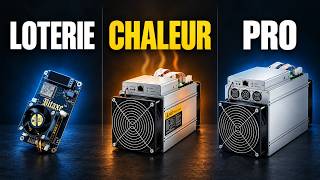 Getting started with Bitcoin mining at home
The principle, the machine, the cost, solo or pool, and the five steps to start.
3 min read · updated 17 Oct 2026 · new
-
 Set up a Bitaxe, step by step
From unboxing to the first share sent to the pool.
2 min read · published 23 Sept 2026
-
 Solo mining on FindMyBlock
Understand solo mining, set up your machine and follow your odds.
2 min read · published 23 Sept 2026