
Which miner for home mining?
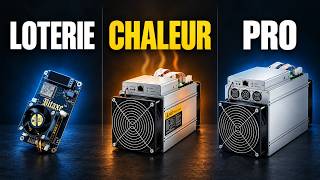
Not every miner belongs in a home. Before hashrate, look at how much it will draw, how much heat and how much noise it will make, where you plan to put it.
Published 23 September 2026 · by Pixel · 2 min read
 8:57
1. The criteria that matter
- Noise. It often decides: a machine running day and night in a living space has to stay quiet.
- Power draw. It runs 24 hours a day: every watt ends up on the bill.
- Heat. All the electricity it uses turns into heat: a bonus in winter, a nuisance in summer.
- Simplicity. To start, a machine you set up from a browser, with a community to help.
2. A few machines, smallest to biggest
Tiny and cheap. Its hashrate Computing power: the number of attempts per second of a machine or of the whole network. The higher it is, the more tickets you play in each draw. is symbolic: perfect to learn, not to hope for a block. My full review.
The best starting point: open source, quiet, and the one in my guides. My full review, and set it up step by step.
The first BM1373 miner: the best efficiency I have measured, with closed software. About €215. My full review.
Roughly four Bitaxes in one, with a power draw that stays reasonable. Its fan is more audible; the water-cooled version is quieter: my NerdQAxe++ Hydro review.
Designed as a small space heater: it mines and warms the room at the same time. The Nano 3S does 6 TH/s for the same power draw: my review.
Eight chips and close to 10 TH/s, for enthusiasts: expect €600 to €650. My full review.
A real farm machine: very loud (around 75 dB) and power hungry. Garage or utility room only, with suitable wiring.
Approximate manufacturer hashrates and power draws. Electricity at €0.20 per kWh, running all year.
Your machine in three questions
Answer, and I will tell you which machine I would start with in your shoes.
3. My advice
Start small. A Bitaxe teaches you everything (setup, pool A server that machines connect to. A regular pool shares the earnings, a solo pool does not. Solo or pool?, shares An attempt good enough to be counted by the pool. It proves your machine is working, even if it is not enough to find a block.) for about fifteen watts. You will then know whether you want to go further, and in which direction.
For your odds of finding a block with each machine, the solo mining calculator works it out live. And if you buy, my partner codes give you a discount.
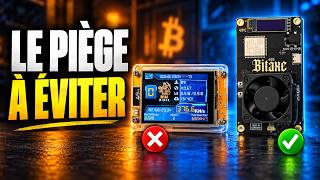
Be wary, though, of ESP32 A microcontroller worth a few euros, the kind in smart plugs. It can compute SHA-256, but millions of times slower than an ASIC chip: an ESP32 miner has no real chance. The lottery miner trap “lottery miners” sold as a chance to win: how to spot them.
A question about this guide? Ask it on the Discord, several of us answer there.
Other guides
-
 Getting started with Bitcoin mining at home
The principle, the machine, the cost, solo or pool, and the five steps to start.
3 min read · updated 14 Nov 2026
-
How much does a Bitaxe earn?
The honest math: average earnings, electricity and jackpot odds.
2 min read · updated 14 Nov 2026
-
 Set up a Bitaxe step by step: Wi-Fi, AxeOS and pool
From power-up to the first share: Wi-Fi, AxeOS, every pool field and quick fixes.
10 min read · updated 14 Nov 2026
-
 Fake Bitcoin miners: the ESP32 lottery miner trap
An ESP32 is not a mining chip: three questions so you never pay $50 for a device that would take 52 billion years to find a block.
5 min read · updated 14 Nov 2026