
Heating your home by mining Bitcoin: the real math
Yes, a Bitcoin miner heats: almost all the electricity it draws ends up as heat in the room, just like an electric heater. So it only really makes sense in winter, in a room heated by electricity: against a heat pump the miner loses, and against gas it is close. Below: the math machine by machine, my own shelf on a French Tempo plan, and what to check for noise and safety.
Published 28 October 2026 · by Pixel · 14 min read
 12:07
A Bitcoin miner turns almost all the electricity it draws into heat: per kWh it heats like an electric heater, and the sats are a bonus. An air-to-water heat pump delivers 2.9 kWh of heat per kWh of electricity on average (ADEME, France, 2025). A 140 W Avalon Nano 3S is only a small space heater.
Contents 8 parts and a FAQ · 14 min read
- Does a Bitcoin miner heat like an electric heater?
- How much does each machine heat, and what does its heat cost?
- When does heating with a miner make sense?
- My shelf: 500 to 600 W, Tempo and red days
- The Avalon Nano 3S: a miner designed to heat
- Noise and safety: what to check before heating with a miner
- What about hot water? A water heater that mines
- The limits, honestly
1. Does a Bitcoin miner heat like an electric heater?
Yes, watt for watt. A miner stores no energy: it lifts nothing, charges no battery, and its calculations carry practically nothing away. The electricity it draws for its chips, power supply and fan therefore ends up as heat in the room, give or take a speck: a little light escaping through the window, the Wi-Fi signal going through the walls. The rest, LED light and fan noise included, is absorbed by the room as heat. A 140 W miner heats like a 140 W heater.
A standard electric heater, whether a convector, a radiant panel, a storage heater or a fan heater, does exactly the same: 1 kWh of electricity gives 1 kWh of heat. Per kWh, a miner therefore heats as much as an electric heater, and the sats are a bonus. That is the whole idea of the “Bitcoin heater”, and also its limit: it does not heat better, it heats the same.
A heat pump plays in another league: it does not make heat, it captures heat from the outside air, water or ground and brings it indoors. Across 100 homes fitted with one and monitored in real-life use, ADEME, the French energy agency, measured on average 2.9 kWh of heat per kWh of electricity for air-to-water heat pumps, from 1.8 for the most poorly set up to over 4 for the best (ADEME, October 2025). The ground-source heat pumps in the study reach 4.3 on average, and during the cold snap of 20 January 2024 the sample still averaged 2 (French Ministry of Economy). A miner stays at 1: for the same heat, it uses close to three times more electricity than an average air-to-water heat pump.
2. How much does each machine heat, and what does its heat cost?
A miner’s heating power is its power draw: just read its watts. Here are the 9 machines reviewed on this site, from the hottest to the most frugal, with what they cost and earn in a year. The last column is the one that matters for heating: the real price of a kWh of heat once average earnings are taken off. Each machine’s name links to its review.
| Machine | Heating power | Electricity a year | Average earnings a year | Net price of a kWh of heat |
|---|---|---|---|---|
| NerdQX 8T, 7.8 TH/s | 165 W (from the interface) | €289 | €93 | €0.14 |
| Thor P2, 10 TH/s | 153 W, overclock Pushing the chip's frequency and voltage for more hashrate. It draws and heats noticeably more: on the Thor X1, +50% hashrate for 2.1 times the power. The review profile (measured at the wall) | €268 | €119 | €0.11 |
| NerdOctaxe, 9.6 to 9.7 TH/s | 144 to 146 W (measured at the wall, math uses 145 W) | €254 | €115 | €0.11 |
| Avalon Nano 3S, 6 TH/s | 140 W, high mode (rated figures) | €245 | €71 | €0.14 |
| NerdQAxe++ Hydro, about 4.8 TH/s | about 70 W (rated figures) | €123 | €57 | €0.11 |
| Bitaxe Gamma GT Turbo, 2.28 TH/s | about 50 W (from the interface) | €88 | €27 | €0.14 |
| Thor X1, 2.1 TH/s | 22 W, normal mode (measured at the wall) | €39 | €25 | €0.07 |
| Bitaxe Gamma, 1.2 TH/s | 15 to 18 W (rated figures, math uses 18 W) | €32 | €14 | €0.11 |
| NerdNOS, 0.12 to 0.2 TH/s | under 10 W (rated figures, math uses 10 W) | €18 | €1.9 | €0.18 |
For comparison: an electric heater charges €0.20 for a kWh of heat. The 140 to 165 W machines bring that price down to between €0.11 and €0.14, because their average earnings pay back 29 to 45% of their electricity. Those earnings are what a regular pool would pay, on average and before its fees: they follow the bitcoin price and the network difficulty How many attempts it takes on average to find a block. It adjusts itself about every two weeks. Difficulty explained, and this table is recalculated at every difficulty adjustment. The Thor X1 has the best price per kWh of heat (€0.07), but at 22 W it barely heats anything: for heating, watts are what count, and efficiency only decides what those watts earn.
The power draw in detail, with French EDF prices: how much power a Bitcoin miner uses. And to choose a machine on other criteria than heat: which miner for home mining.
3. When does heating with a miner make sense?
One rule is enough: a miner’s heat saves nothing unless it replaces heating you would have paid for. Surplus heat, the kind that makes you open a window, is wasted. So it all depends on the season, and on what heats the room today.
| Heating | Price of a kWh of heat | Where the figure comes from |
|---|---|---|
| Electric heater (convector, panel, storage heater) | €0.20 | all the current becomes heat, at €0.20 per kWh |
| Miner, solo, until a block lands | €0.20 | like a heater: heat at full price, the block as a ticket |
| Miner in a pool, 140 to 165 W machines | €0.11 to €0.14 | electricity minus average earnings, network as of 17 October 2026 |
| Air-to-water heat pump | €0.07 | average COP of 2.9 measured by ADEME across 100 homes (2025), electricity at €0.20 |
| Gas | €0.158 per kWh of gas | French CRE reference price for November 2026 (gas-heated household, standing charge excluded), before boiler losses |
| Heater or miner, a Tempo red day from 6 am to 10 pm | €0.73 | price including taxes as of 1 August 2026 (CRE price schedule) |
- In winter, in a room heated by electricity: yes. That is the ideal case. Each kWh from the miner replaces a kWh from the heater, at the same price, and the sats come on top. The heater still has to turn down in response: with a thermostat, it heats less by itself. Keep the miner away from the thermostat, or the heater will think the room is warmer than it is.
- Against a heat pump: no. Even after average earnings, a miner’s kWh of heat costs at least 1.6 times that of an average air-to-water heat pump. In a room heated by a heat pump, the miner just makes the heat pump run less: you replace heat at €0.07 with heat at €0.11 or more. According to a preliminary ADEME study quoted by the French Ministry of Economy, replacing electric heaters with an air-to-air heat pump would even halve heating consumption, cold snaps included.
- Against gas: it is close. Per kWh, gas costs less than electricity: about €0.158 for a gas-heated household, according to the French regulator’s reference price for November 2026, against €0.20. That reference price is only a guide: your contract may cost more or less. With a regular pool’s average earnings, though, the 140 to 165 W machines go below it: their heat comes to between €0.11 and €0.14 per kWh (network as of 17 October 2026), and a boiler never turns all of its gas into heat. This math stays fragile: it depends on the bitcoin price, counts neither the price of the machine nor pool fees, and assumes your central heating really turns down in response, thanks to a thermostatic valve on that room’s radiator. Solo, until a block lands, gas keeps the edge.
- In summer: never. The heat is worth nothing, every kWh becomes a cost again, and if you run air conditioning, you also pay to remove it.
In the video, I did my math at €0.25 per kWh; here, as everywhere on this site, at €0.20. Replace it with your own contract’s price: at €0.25, every net price in the table goes up.
4. My shelf: 500 to 600 W, Tempo and red days
At home, 13 machines, about 50 TH/s, run on a shelf and draw 500 to 600 W day and night: about €70 of electricity a month on my Tempo plan with EDF, a French tariff where each day has a colour. In winter their heat warms the room, and the Avalon Nano 3S, which is on the shelf, is even designed for it. No block has landed yet: solo, that heat therefore costs me its full price for now, the price of a heater of the same power, and the block remains a ticket.
On Tempo, the price per kWh depends on the colour of the day. A day at 550 W costs me about €2.05 on a blue day, €2.37 on a white day and €7.13 on a red day, at the 1 August 2026 prices (CRE price schedule, taxes included, off-peak from 10 pm to 6 am). The 22 red days all fall on weekdays, outside public holidays, between 1 November and 31 March (EDF): right in the season when the heat is useful. On their own, they would cost the shelf about €157, against €45 if they were blue.
On a red day, from 6 am to 10 pm, a kWh costs about €0.73, 4.4 times the blue-day price at the same hours. A miner’s heat then costs exactly that, just like a heater’s. If it replaces a thermostat-controlled electric heater in the same room, switching the miner off only moves the cost. Otherwise, that is the day when low mode, or switching it off from 6 am to 10 pm, pays off most: an Avalon Nano 3S costs about €0.10 an hour then, for less than one cent of average earnings. The full Tempo math for a miner: power use and electricity cost.
New this winter: from 1 November 2026, RTE, the French grid operator, picks red days with the peak-day method of the capacity mechanism, to spread them better over the winter, and 24 and 31 December can no longer be red (CRE decision of 21 October 2026). The next day’s colour is still announced the day before, in the late morning.
5. The Avalon Nano 3S: a miner designed to heat
Canaan describes it as “another portable small heater that can generate Bitcoin”. It has an adjustable air outlet, three modes (low, medium, high) in the Avalon Family app, and its official page rates it for a room at 30 °C at most, with 30 dB in low mode. It sits on my shelf: very quiet, you can keep it next to you while working, even in a bedroom. My full Avalon Nano 3S review.
Its 140 W give about 3.4 kWh of heat a day running non-stop, for about €0.67 of electricity at €0.20 per kWh (€0.52 on a Tempo blue day, €1.81 on a red day). It is a desk heater: enough to take the chill off the spot where you work, not to heat a cold room.
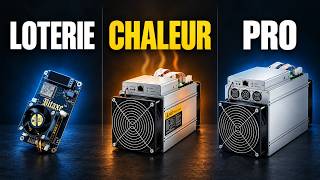
In the video, I compare it with two bigger machines that I have not reviewed: the Avalon Mini 3, which Canaan presents as a household heater, rated at 37.5 TH/s for 800 W, and the Magic Miner 40T, rated in three modes, 30 TH/s at 450 W, 40 TH/s at 650 W or 50 TH/s at 850 W. At that power you are talking about real room heating, with the noise that comes with it: Canaan rates the Mini 3 at 35 to 55 dB.
I also present a project I have not built yet: recovering the heat of an Antminer S19k Pro hashboard, measuring its draw at the wall, its hashrate Computing power: the number of attempts per second of a machine or of the whole network. The higher it is, the more tickets you play in each draw., its noise and its effect on the room. It is not a tested setup, and I will not give figures before I have measured them.
6. Noise and safety: what to check before heating with a miner
Noise, especially at night. A fan running non-stop is far more noticeable in a quiet bedroom than in an office. In my reviews, the Avalon Nano 3S (33 to 40 dB rated) stays very quiet, the Thor P2 drops to about 35 dB in its Low profile against 44 dB measured at 10 TH/s, the NerdQX 8T is rated under 45 dB, and the NerdQAxe++ Hydro, water-cooled, makes a noise that is easily acceptable in a living room. The stock fan of the Bitaxe Gamma GT, on the other hand, is very loud, and the Thor X1 is rated at 51 dB in overclock. For a bedroom, pick a quiet machine and switch it to low mode at night: less noise, and less heat too.
- Socket and power strip. Add up your machines’ watts and compare them with the maximum power marked on the power strip, on or under its base. Never plug one power strip into another, use a strip marked NF or CE with a built-in breaker, and a wall socket for the hungriest machines. Promotelec, a French association specialised in electrical safety, recommends never plugging electric heaters, convectors or space heaters into a power strip: a shelf of miners that heats the room deserves the same treatment.
- Airflow. Never cover a miner: no laundry drying on it, no cushion, no closed cabinet, no curtain in front of the grilles. Keep the air inlet and outlet clear: a smothered machine runs too hot and loses hashrate.
- Dust. A miner stirs the room’s air day and night. Canaan says it dust-proofed the Nano 3S, but regular dusting of the fan and heatsink is still the rule: cleaning a miner that runs hot.
- The room. No damp room such as a bathroom, no room warmer than the maker’s rated limit, and machines out of reach of children and pets.
7. What about hot water? A water heater that mines
For hot water, a desk miner is no match. Heating one litre of water by one degree takes about 1.16 Wh: a 200-litre tank raised from 15 to 55 °C therefore needs about 9.3 kWh. Even if all its heat went into the water, an Avalon Nano 3S would take about 2.8 days. And air-cooled machines heat air, not water; the NerdQAxe++ Hydro is water-cooled, but in a closed loop with its own radiator: its heat also ends up in the room’s air.
There is a health question too. Water that is only lukewarm favours Legionella: for a house, the ARS Bretagne, a French regional health agency, recommends hot water of at least 50 °C, and at most 60 °C, at the kitchen tap. A miner that pre-heated the tank would still not spare you heating it afterwards. For cheaper hot water, the heat pump equivalent exists: the heat pump water heater, a small heat pump dedicated to hot water (ADEME).
8. The limits, honestly
- A desk miner is a small heater. At 140 W, the Avalon Nano 3S is about a quarter of my shelf and less than a fifth of the Avalon Mini 3. It does not replace a radiator in a cold room: the power you need depends on insulation, room size and how cold it is outside.
- Solo, the average never lands. A Nano 3S has about 1 chance in 3,190 per year of finding a block (network as of 17 October 2026): by far the most likely outcome is earning nothing all winter. If you mine solo, on FindMyBlock, the pool I run (0% fee), or elsewhere, count the heat at full price and the block as a ticket. Your odds machine by machine: the solo mining calculator. And why solo and pool pay the same on average: solo or pool.
- The purchase price counts. A miner costs far more than a heater of the same power: about $397 delivered for a Thor P2, €600 to €650 for a NerdOctaxe, from $299 on Canaan’s product page for an Avalon Nano 3S (October 2026). The net prices in the table leave it out.
- Earnings move. They follow the bitcoin price and the network difficulty: if the price falls or the difficulty climbs, the net price of the heat goes back up towards €0.20. The full picture for mining in 2026: is Bitcoin mining profitable?, and the step-by-step math for a small miner: how much a Bitaxe earns.
Network figures as of 17 October 2026, recalculated at each difficulty adjustment. This is not investment advice, nor a sizing of your heating.
Frequently asked questions
Does a Bitcoin miner heat as much as an electric heater?
Yes, at equal power: almost all of a miner’s electricity ends up as heat in the room, like a convector’s. A 140 W miner therefore heats like a 140 W heater, which is not much: about 3.4 kWh of heat a day running non-stop.
Is heating with a Bitcoin miner worth it?
Against an electric heater, yes on average, not counting the price of the machine: in a regular pool, earnings pay back 29 to 45% of the electricity of 140 to 165 W machines (network as of 17 October 2026). Against an air-to-water heat pump, which delivers 2.9 kWh of heat per kWh on average (ADEME), no. Solo, the most likely outcome is earning nothing all winter.
How many watts of miner does it take to heat a room?
Several hundred watts, depending on insulation, room size and how cold it is outside. My 500 to 600 W shelf warms the room in winter, and the Avalon Mini 3, which Canaan presents as a heater, is rated at 800 W. A 140 W Avalon Nano 3S takes the chill off a desk, it does not heat a cold room.
Can a Bitcoin miner heat a hot water tank?
Not a desk miner: a 200-litre tank raised from 15 to 55 °C needs about 9.3 kWh, close to 3 days of an Avalon Nano 3S even if all its heat went into the water. And lukewarm water favours Legionella: a French regional health agency, ARS Bretagne, recommends at least 50 °C at the kitchen tap. For hot water, a heat pump water heater is far more efficient.
Is the Avalon Nano 3S a good space heater?
A small one. Canaan rates it at 6 TH/s for 140 W and 33 to 40 dB: about 3.4 kWh of heat a day running non-stop, quiet enough for a bedroom. It takes the chill off a desk or a small room, it does not replace a radiator. My full Avalon Nano 3S review.
Sources
- ADEME Infos: air-to-water heat pump performance measured in 100 homes (October 2025, in French)
- French Ministry of Economy (Bercy décode): are heat pumps efficient in winter? (in French)
- EDF: how the Tempo option works (blue, white and red days, hours), in French
- CRE: regulated tariff price schedules as of 1 August 2026, Tempo option (deliberation 2026-147, annex B, PDF, in French)
- CRE: reference price of natural gas for households (November 2026 grid, in French)
- Canaan: the official Avalon Nano 3S page (rated figures)
- Promotelec: appliances not to plug into a power strip (14 November 2025, in French)
- ARS Bretagne (French regional health agency): Legionella and hot water temperature at home (in French)
A question about this guide? Ask it on the Discord, several of us answer there.
Other guides
-
 Is Bitcoin mining still profitable in 2026?
The math for every machine: pool earnings, electricity, break-even and halving.
11 min read · published 28 Oct 2026 · new
-
 How much power does a Bitcoin miner use, and what does it cost?
The formula, every machine costed, and EDF Base and Tempo prices from August 2026.
13 min read · published 28 Oct 2026 · new
-
 How much does a Bitaxe earn?
The honest math: average earnings, electricity and jackpot odds.
2 min read · updated 17 Oct 2026
-
 Miner running hot: cleaning, thermal paste and cooling
Spot overheating, fix it, and gain some hashrate along the way.
2 min read · published 24 Sept 2026