
Where to store your seed phrase: paper, steel or titanium?
Where should you store a seed phrase? On a physical backup, never on a connected device, in at least two copies, and away from the wallet itself. Paper is fine to start with, but water and fire destroy it; a metal plate lasts far longer, as long as you pick the right design. Here is what the BIP39 standard says, what stress tests on 75 metal backups showed, and how to store and pass on your copies without exposing them.
Published 2 November 2026, updated 14 November 2026 · by Pixel · 15 min read
A seed phrase is the list of 12 or 24 words (the BIP39 standard) that recreates your Bitcoin wallet. Keep it offline: on paper to start, then on a single solid plate of stainless steel or titanium, stamped or punched, in two copies kept in two different places. Never as a photo, in the cloud or in a password manager.
Contents 8 parts and a FAQ · 15 min read
- What is a seed phrase, and why 12 or 24 words?
- Why should you never store a seed phrase as a photo, in the cloud or in notes?
- Is a paper seed phrase backup enough?
- Metal seed phrase backup: punched, engraved or letter tiles?
- Stainless steel or titanium: which metal?
- Where should you keep your seed phrase copies?
- Passphrase, Shamir or multisig: do you need more?
- Inheritance: how do you pass on a seed phrase without exposing it?
1. What is a seed phrase, and why 12 or 24 words?
A seed phrase, or recovery phrase, is a list of 12 to 24 words that your wallet picks at random when you create it. It is enough to rebuild all your private keys The secret that proves some bitcoin belongs to you and lets you spend it. Your wallet keeps it; the recovery phrase can rebuild it., and so access to your bitcoin, on any compatible wallet. The wallet is only a tool: if it breaks, gets lost or stolen, these words give you your funds back. And anyone who reads them can do exactly the same, without your device.
The format comes from the BIP39 standard, published in the official Bitcoin Improvement Proposals repository. Each word comes from a list of 2,048 words, and the standard allows 12, 15, 18, 21 or 24 words: 12 words carry 128 bits of randomness, 24 words carry 256. With 12 words there are already 2 to the power of 128 possible phrases, a 39-digit number: nobody guesses a randomly generated seed. Both lengths are standard. Keep the one your wallet gave you, and pick a backup with room for 24 words if that is what you have.
Wordlists exist in other languages, but BIP39 says their use is “strongly discouraged”, because the vast majority of wallets only read the English list. Three details matter for the backup:
- The order of the words is part of the secret. Always number them, 1 to 12 or 1 to 24.
- Part of the last word is a checksum. It lets the wallet catch a copying mistake, but not every one, and it cannot tell you which word is wrong: BIP39 lists this among its shortcomings.
- The first four letters are enough. The English list was built so that the first four letters identify each word unambiguously: “about” and “above” only part at the fourth letter. Across the 2,048 words of the official list, no four-letter start repeats, and the 103 three-letter words, such as “zoo”, are written in full. That is what makes 24 words fit on a small plate.
2. Why should you never store a seed phrase as a photo, in the cloud or in notes?
Because a seed copied onto a connected device can be read by someone else without you knowing, and the words alone are enough to empty the wallet. A hardware wallet A small device that holds the keys and signs transactions without ever showing them to the computer. Always check on its screen what you approve. exists precisely so that these words never pass through a computer or a phone: copying them there cancels its protection. It is beginner mistake number 1.
- A photo often uploads itself to the phone’s cloud backup, and it stays in the gallery, within reach of a nosy app or of anyone holding your unlocked phone.
- A note, a file, an email are synced to servers. Jameson Lopp, a well-known Bitcoin security specialist, puts taking a photo of your seed and cloud-synced note apps among the backup methods that are bound to fail: one hacked account is enough, or one employee of the service with access.
- A password manager beats a plain note, but it is still software on a connected device. Spyware on the computer, a phished master password or a leak of the online vault, and the seed goes out with everything else.
- A screenshot, copy and paste, a printout: the seed then passes through the memory of a device, sometimes a printer. Same rule.
And nobody has a legitimate reason to ask for it. Not a brand’s support, not an exchange, not a site offering to “verify” your wallet, not a Discord or Telegram admin. Trezor puts it in writing: no legitimate company, Trezor included, will ever ask for your wallet backup, and any such request is a scam. The only reason to take it out is to restore your wallet yourself, following the device’s official instructions. Fake support agents multiply after every big hack: see the scams to expect after the Binance hack.
Even a seed never typed anywhere can be read by a device tampered with before the sale, as the tampered Ledger case showed. Buy your wallet new, preferably from the manufacturer, and refuse any device that arrives with words already written down.
3. Is a paper seed phrase backup enough?
To start, and for a small amount, yes, as long as you protect it well. For savings you plan to keep for years, paper alone is fragile. Most hardware wallets come with a card to fill in; OneKey itself writes, in its help centre, that relying solely on these cards may be insufficient for long-term security.
Paper has three enemies:
- Water: a leak, a flood, or the firefighters’ hoses after a fire. A felt-tip pen or ink that runs can make a word unreadable.
- Fire: a house fire peaks at around 704 °C (1,300 °F), according to the figures Lopp quotes, and paper burns long before that.
- Time and forgetfulness: a sheet tears, fades, or gets thrown out with old paperwork.
If you go with paper, do it properly:
- Copy the words by hand, in capitals, with a ballpoint pen rather than a felt-tip, each one with its number.
- Check each word against the BIP39 list: its first four letters must match exactly one word on the list.
- Make two copies, to keep in two different places (see below).
- Put each copy in a sealed plastic sleeve, then in an opaque envelope. Lopp suggests a tamper-evident bag that you sign: you can see at a glance whether someone opened it.
4. Metal seed phrase backup: punched, engraved or letter tiles?
A single solid plate of stainless steel or titanium, with letters stamped or dots centre-punched deep into it, is the backup that holds up best. Systems made of small letter tiles slid into a rail are the most fragile. This is not a sales pitch: it is what comes out of Jameson Lopp’s stress tests, in which he put 75 metal seed backups through the wringer and published the results for free.
His method is public: a propane torch flame at 1,093 °C (2,000 °F) for 10 minutes, slightly hotter than a house fire, then a water quench, the way firefighters would put it out; then 12 hours in a bath of 16% muriatic (hydrochloric) acid; then a 20-ton hydraulic press. He warns that these are not highly scientific experiments and that his grading is arbitrary: the goal is to compare devices with each other. Of the 75, 45 get an overall A and 5 get an F (table read on 2 November 2026).
| Backup | Fire | Water and corrosion | Crushing | Takeaway |
|---|---|---|---|---|
| Paper, written in pen | burns well before the roughly 704 °C (1,300 °F) peak of a house fire | water can wash out the ink or tear the sheet | barely affected | fine to start, two copies, in a sealed sleeve |
| Single solid plate in stainless steel or titanium, centre-punched dots or stamped letters | survives, unless the marks are too shallow | usually survives; a thin plate or a shallow template can fade | survives, unless the plate is very thin | the design Lopp recommends |
| Letter tiles slid into a rail | on several models the rail warped and tiles fell out | little affected by the acid | most of them drop their tiles | avoid, or use one tile per word, numbered |
| Aluminium casing | melted within 5 to 6 minutes on several models | eaten by the acid | nothing left to crush | avoid |
| Light engraving, ink, thin copper foil | engraved words gone where the flame hit | ink and printed templates wiped off | a thin foil does not survive it | avoid for a seed |
What makes the difference, according to his reviews and the treatise he drew from them:
- Letters in a rail: heat warps the rail, or crushing opens it, and tiles fall out. Jumbled, 96 letter tiles (4 per word for 24 words) can be ordered in roughly 10 to the power of 150 ways. If you must use pieces, Lopp advises one piece per word, with its number on it.
- Light engraving and printed templates: on one tested plate, the engraved words vanished where the flame hit, while the stamped words stayed readable. Lopp has also seen ink-printed templates wear off, and recommends a template etched as deep as the data.
- Aluminium: several aluminium casings melted within 5 to 6 minutes of flame. Lopp points out that this metal melts at common house fire temperatures.
- A plate that is too thin bends with pliers and can dissolve in acid. Lopp recommends at least 5 mm of thickness to limit flexing, and finds that small devices deform less than large ones.
His bottom line fits in one sentence: simpler is better. The best bang for your buck, in his view: a single plate with a grid of dots to centre-punch. In practice, he finds a centre punch far simpler than letter stamps struck with a hammer, a method he says he hates after thousands of strikes. On a plate, the first four letters of each word are enough; on paper, write the full word, it is easier to read back.
5. Stainless steel or titanium: which metal?
Both work: according to Lopp, they are the only two common metals that combine a high melting point, corrosion resistance, strength and hardness. The shape of the plate and the depth of the marks matter more than the metal.
- Stainless steel: it melts at around 1,400 to 1,450 °C for grade 304, and around 1,375 to 1,400 °C for grade 316, according to Lopp’s figures. He recommends 316L, which resists salt better, and corrosion where the strikes have deformed the surface. Not all stainless steel is the same, he warns: on one punched plate sold as 304 steel, his acid wiped out almost all the markings and covered it in misleading noise.
- Titanium: Lopp suggests grade 4, the strongest, or grade 7, the most corrosion resistant. In his acid bath he saw substantial pitting on the surface of some titanium devices, with a tiny loss on the most lightly stamped letters, but a seed still recoverable.
Keep it in perspective: both metals stay solid far above the roughly 704 °C of a house fire, and Lopp himself thinks strong acid is probably not a threat you need to worry about. In the reviews of the devices that failed, the same causes keep coming back: a rail, screws, aluminium, a plate that is too thin, or marks that are too shallow. Lopp also advises never having a seed plate shipped to your home, or to wherever you will keep it, on the assumption that the shipping address will leak: he suggests a private mailbox or a remailing service, or failing that a do-it-yourself build.
One option among others: the OneKey KeyTag. It is a small plate of TC4 titanium alloy, 36 × 33.5 × 3 mm and 14 g, sold as a pair with an automatic centre punch and a guide, for $59 a kit on the official product page in early November 2026 (prices change). You do not stamp letters on it: you punch dots that encode each word’s number in the BIP39 list. OneKey says it records 24 words in total, front and back, plus two extra lines for passphrases. Its design, a single solid plate with punched dots, is the one Lopp rates as the best value. To be complete: the KeyTag is not in his tests, the resistance up to 1,668 °C is claimed by the manufacturer, not measured by a third party, it is 3 mm thick where Lopp recommends 5, and Lopp notes that encoding word numbers copes less well with an unreadable character than encoding letters (up to ten possible words instead of about two). If you want to look at it: the OneKey shop (partner link: I earn a commission, at no extra cost to you). Other punched plates work too, as do the do-it-yourself builds from hardware-store materials that Lopp lists.
6. Where should you keep your seed phrase copies?
At least two copies, in two different places, and never next to the wallet. A burglar who finds the device and the seed in the same drawer has everything; a fire that destroys both leaves you with nothing. Even a plate that survives a fire may be out of reach: Lopp notes it can be washed away by fire hoses, picked up in the rubble, or stuck in a house nobody is allowed into.
The flip side: every complete copy is one more place where someone can find it. Two well-hidden copies beat five scattered ones. A few simple rules:
- One place at home, hidden, but not in the wallet’s box or in a folder labelled “Bitcoin”.
- A second place away from home: with a trusted relative, in a sealed envelope, or in a bank safe deposit box.
- A sealed, signed bag so you can tell if it was opened, and a look at it from time to time.
- Do not cut the phrase in two halves, and do not shuffle the words to scramble it. Lopp explains that splitting it weakens it badly, and that 12 shuffled words can only be ordered in 479 million ways, which a well-equipped attacker checks in a matter of hours.
Test your backup before you put a large amount on it. Lopp’s method: create the wallet, make your copies, send a small amount to it, wipe or reset the wallet, restore it from your copy, then check that the amount is back and that you can spend it. To move your bitcoin from an exchange to that wallet next: withdrawing to a hardware wallet, step by step.
7. Passphrase, Shamir or multisig: do you need more?
These options protect you against someone who finds your seed, but each one adds a piece you can lose. For a beginner, a well-backed-up seed in two copies is already a very good base.
The passphrase, sometimes called the “25th word”, is part of BIP39: a word or phrase of your choice that is added to the seed and opens a different wallet. Its strength and its trap come from the same rule: according to the standard, every passphrase produces a valid wallet, and only the right one opens yours. A thief who finds your 24 words without the passphrase only opens the base wallet, empty if your funds sit behind the passphrase; but a typo opens an empty wallet for you too. Trezor is blunt about it: a passphrase cannot be changed or recovered, and if you lose it, you lose access to the funds. Lopp compares this setup to a 2-of-2, where you need both pieces, and says he has seen quite a few people locked out because they forgot theirs. If you use one, write it down, and keep it somewhere other than the seed: stored next to it, it protects nothing.
Shamir backup (the SLIP-39 standard) splits the secret into shares An attempt good enough to be counted by the pool. It proves your machine is working, even if it is not enough to find a block., for example three of which any two rebuild it; below the threshold, the shares reveal nothing. Each share is 20 or 33 words from a different list of 1,024 words, and the standard is for the most part not compatible with BIP39: you will need a wallet that supports it, today and in twenty years.
Multisig spreads control across several keys, each with its own seed, for example 2-of-3: one stolen seed is not enough, one lost seed blocks nothing. Lopp, whose company Casa offers this kind of custody, ranks it among the best methods. It is more robust, but slower to set up and to restore.
8. Inheritance: how do you pass on a seed phrase without exposing it?
Someone must know that your bitcoin exists, where the backup is and what to do with it, without having the words today. A perfectly hidden seed known only to you disappears with you. Lopp rules out memorising it as a long-term method, partly because your heirs would have no way to access it.
A simple approach: a letter of instructions, stored somewhere other than the seed, given to a trusted person or kept with your important papers. It says:
- that you hold bitcoin, and on what kind of wallet;
- where the seed copies are and, if there is a passphrase, where it is kept;
- that the seed follows the BIP39 standard, in 12 or 24 words, and how to read the plate if it encodes numbers;
- that nobody serious will ever ask them for these words, no “support agent”, no “recovery expert”;
- the name of a knowledgeable person who can guide them, without ever seeing the words.
It never contains the words themselves. Read it again whenever you change wallet or hiding place.
For a miner, this matters twice over. In solo mining, on FindMyBlock, the pool A server that machines connect to. A regular pool shares the earnings, a solo pool does not. Solo or pool? I run, as on other solo pools that write your address into the block, a block reward goes straight to your wallet address: the day your machine finds one, this seed is what protects the block. See also what happens after you find a block.
Frequently asked questions
Is a 12-word seed phrase enough, or do I need 24?
12 words carry 128 bits of randomness and 24 words carry 256, according to BIP39. Both lengths are standard, and a randomly generated 12-word seed cannot be guessed. Keep the one your wallet gave you, and choose a backup with room for all your words.
Can I take a photo of my seed phrase?
No. A photo often ends up in the phone’s cloud backup, and anyone who sees it can empty your wallet without your device. Copy the words by hand, on paper or metal, never on a connected device.
Steel or titanium seed plate: which is better?
Both work: stainless steel, ideally 316L, and titanium are the two metals Jameson Lopp recommends after testing 75 devices. The design matters more: one solid piece, letters stamped or dots punched deep, no letter tiles slid into a rail.
Do I need to stamp the whole word on a metal plate?
No: in the BIP39 English list, the first four letters are enough to identify each word, and three-letter words are written in full. On paper, still write the full word, it is easier to read back.
Support is asking for my seed phrase, is that normal?
No, it is a scam: refuse and cut contact. No legitimate company will ever ask for your seed, and Trezor states that any such request is one. Only contact the brand through its official website.
What if someone saw my seed phrase?
Treat it as compromised: create a new wallet with a new seed, back it up, then move your funds to it. Restoring the old seed on another device does not take access away from the person who saw it.
Sources
- BIP39, the 12 to 24 word mnemonic standard (bitcoin/bips repository)
- Jameson Lopp, stress tests of 75 metal seed storage devices
- Jameson Lopp, a treatise on seed backup device design
- Jameson Lopp, how to back up a seed phrase
- SLIP-39, Shamir’s secret sharing for mnemonic codes
- Trezor, what a passphrase is and what happens if you lose it
- Trezor, scams and phishing: no one will ever ask for your backup
- OneKey, official KeyTag product page (material, size, price)
A question about this guide? Ask it on the Discord, several of us answer there.
Other guides
-
 Hot, cold or hardware wallet: which one should you choose?
Online, offline or on a dedicated device: what sets them apart, and which to pick for your use.
5 min read · published 17 Oct 2026
-
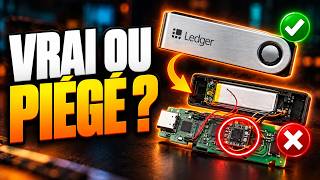 Booby-trapped Ledgers: the CryptoBilis case and how to stay safe
A spy chip stole the 24 words: what was really attacked, the other incidents, and the right moves for your situation.
7 min read · published 17 Oct 2026
-
 Bitcoin: 5 mistakes that can cost you everything
Recovery phrase, exchanges, fees, scams, panic: the five beginner traps, and how to avoid them.
5 min read · published 17 Oct 2026
-
 Binance to Ledger: withdraw your bitcoin step by step, from any exchange
Address checked on the device, BTC network, small test: the safe way out.
13 min read · updated 14 Nov 2026 · new