
Binance hacked: $3.5 billion stolen, and how to keep your own keys
Thursday 29 October, 20:20 UTC. A Binance wallet with more than 31 million transactions behind it changes hands, and four minutes later it is empty. Here is what we know, how to follow the hacker’s money live on the blockchain, and a step-by-step guide so your bitcoin never depends on an exchange again. Updated 30 October 2026 at 02:05 UTC; the live tracking just below updates itself. The investigation is just starting and the figures may still change.
Published 30 October 2026 · by Pixel · 13 min read
LIVE 1 person reading this article
Share this live X WhatsApp Telegram
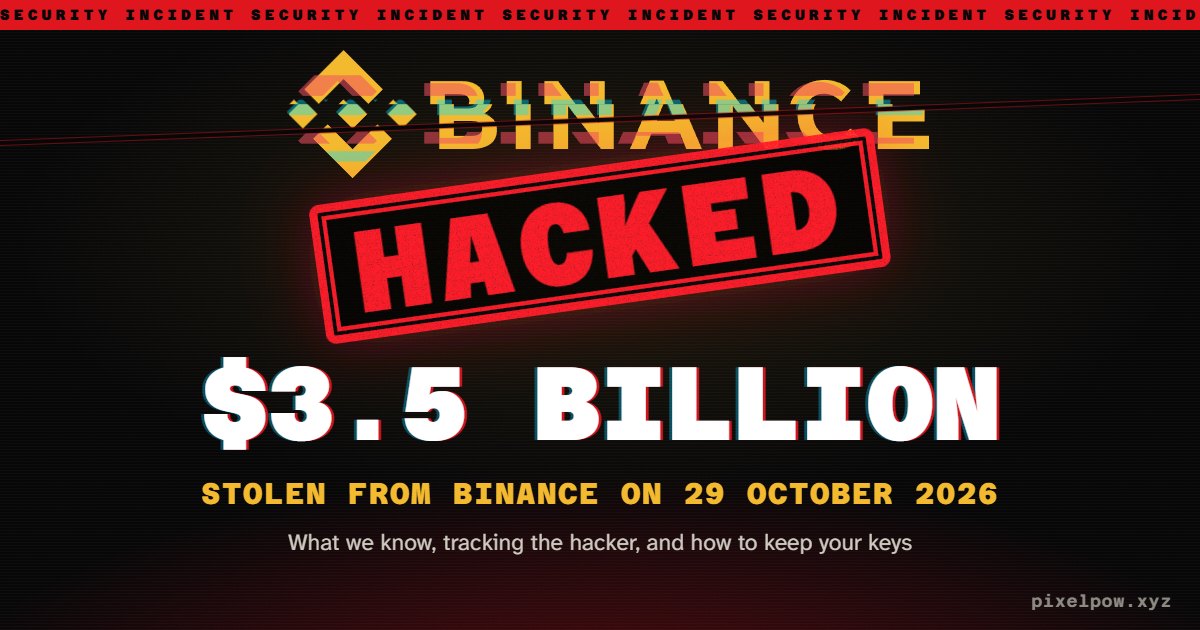
On 29 October 2026 at 20:20 UTC, an attacker took control of a Binance hot wallet through an EIP-7702 delegation and emptied it in four minutes. About $3.5 billion left on Ethereum, including more than $2 billion in stablecoins since frozen by Tether, Circle and Ripple. Binance only cut the hacker off at 00:10 UTC, almost four hours later. Binance calls it a “security incident”, has suspended deposits and withdrawals, and promises to cover all losses. The lesson stays the same: bitcoin on an exchange is the exchange’s promise; in your own wallet, it is your bitcoin.
Contents 6 parts and a FAQ · 13 min read
1. Live tracking: the hacker’s money
This part updates itself: the balances of the hacker’s addresses are read from the blockchain every two minutes confirmed. I track the main addresses here; Arkham attributes 70 to the hacker, listed on its Arkham page. Figures as of 30 October 2026 at 00:45 UTC.
| Role | Address | Right now |
|---|---|---|
| The drained wallet | 0x28C6c062…f21d60 |
Binance 14, delegation to the hacker cancelled at 00:10 |
| The starting address | 0x7C8601d4…6B5CA0 |
funded through Tornado Cash, it launched the attack |
| The hacker’s contract | 0x63e842B0…9c6fAe |
the program that emptied Binance 14 |
| The main loot | 0x5227f603…CB2f8c |
1.18 billion USDT and 823 million USDC frozen, about 2,000 ETH |
| The ETH reserve | 0x8532FA14…0543D4 |
195,460 ETH, about $440 million, untouched since 20:38 |
| The second reserve | 0x897C80d1…158DF3 |
78,415 ETH, about $176 million, arrived through relay wallets, no outflow |
| The second address | 0xA97bF783…AE8d10 |
about fifty small tokens taken at 22:39, then 2,962 ETH at 23:56 |
Where the money goes. The hacker is scattering the tokens that cannot be frozen (PEPE, UNI, LINK, AAVE…) to fresh addresses, and part of the 700 million USDT that left before the freeze has gone through Uniswap to become ETH, which nobody can block confirmed. The hacker also reportedly deposited 60 million USDT on Aave to borrow about 19,800 ETH before Aave froze its markets, according to Decrypt unconfirmed.
Two habits while you follow this. Send nothing to these addresses and do not interact with any token that comes from them. And look at the details: the loot’s history already shows fake “USDT”, with names stuffed with invisible characters, sent to addresses that start and end like the hacker’s own. That is address poisoning: scammers are even baiting the hacker, hoping the wrong address gets copied. It is used against you too, more on that in the step-by-step guide.
2. What we know about the Binance hack
On 29 October 2026, about $3.5 billion in crypto left a Binance hot wallet A wallet connected to the internet: app, software or extension. Handy day to day, but more exposed to attacks. Hot, cold or hardware?, “Binance 14”, for addresses controlled by an unknown party. That is Arkham’s estimate as reported by The Block ($3.55 billion), and my own count on the blockchain lands in the same range: about $3.75 billion at 23:45 UTC prices. Adding bitcoin and Tron outflows that the Ethereum attack does not explain yet, Arkham counts more than $5.7 billion on the hacker’s addresses and Chainalysis puts the total at $5.9 billion, according to CoinDesk unconfirmed. On the addresses Arkham attributes to the hacker, there would be about 18,270 BTC, $1.44 billion that has not moved yet, 400,000 to 467,000 ETH depending on the snapshot time, 1.77 billion USDT and 823 million USDC, the latter two largely frozen unconfirmed. Arkham stresses that this is the value held on those addresses, not a confirmed amount stolen. Binance has published no figure.
The sequence, in UTC, from the blockchain and CryptoTicker’s timeline:
Each fact carries a label: confirmed = seen on the blockchain or officially stated by the party concerned; unconfirmed = estimate, analysis or second-hand report, to be taken with care.
the hacker’s starting address receives its first ETH from Tornado Cash, a service that hides where funds come froma single transaction ties Binance 14 to the hacker’s contractBinance 14 sends 167,464 ETH, 1.6 billion USDT and more than 60 other tokens to the hacker, for less than a dollar in fees28,005 ETH arrive from a second Binance wallet780 million USDC follow, then 43 million at 20:59CZ, Binance’s founder: “It does look like a hack on Binance”Circle, then Tether, say they froze more than 800 million USDC and more than 1.5 billion USDTthe hacker comes back: 200 million USDT, then about fifty small tokensBinance 14 sends what it has left to another Binance walletBinance reports $2.54 billion in verified frozen assets, a total that may still risea 2,962 ETH deposit lands on Binance 14: one minute later, the hacker takes itBinance co-CEO Yi He: “Binance will cover all hacking losses”Binance suspends all deposits and withdrawals during its security checks and promises a full post-mortem once the investigation is completeBinance finally cancels the delegation: Binance 14 is an ordinary wallet againArbitrum freezes about $30 million tied to the hack on its blockchainBinance raises verified frozen assets to $3 billionArkham turns the hacker into an official entity and says it has verified 70 linked addressesthe hacker reportedly swapped 7 tokens for 70,480 ETH, about $158 million, according to analyst EmberCNthe hacker gets busy: more than 180 transactions from the loot address, whose balance goes from about 2,000 to 10,700 ETH, and 151 from the second addressWhat Binance says. Its first post, at 21:16, said it had “not confirmed any impact to user funds”. It was edited twice in thirteen minutes, FinanceFeeds notes, ending with: “User funds are completely safe.” A spokesperson told TechCrunch that Binance “temporarily suspended withdrawals on multiple networks following a security incident as a precautionary measure.” CZ, who no longer runs Binance, says that, as a shareholder, CZ expects all user funds to be fully covered. Around 00:00 UTC, Binance co-CEO Yi He went further: “Binance will cover all hacking losses” confirmed. That is a public commitment, but with no amount or timeline, and Binance has not said whether it will draw on its SAFU emergency fund, about $1 billion held in bitcoin. Yi He also thanked Ripple, which froze about $200 million of RLUSD, its stablecoin, according to Decrypt. During the night, Binance reported $2.54 billion in verified frozen assets, across all coins, then $3 billion at 00:52 UTC confirmed, and suspended deposits too, promising a full post-mortem “once the investigation is complete”, according to Cointelegraph’s live coverage.
Withdrawals. At 22:32 UTC, according to Binance, withdrawals in BTC, ETH and USDT on Ethereum and Tron were going through. Those on Solana, XRP, and stablecoins on Solana, Optimism, Avalanche, NEAR and Polygon were paused for “wallet maintenance”. Since 00:07 UTC, Binance has suspended all deposits and all withdrawals during its security checks, with no restart date.
The market. BNB, Binance’s token, fell as much as 6% in half an hour, and about $628 million of leveraged positions were liquidated within an hour, according to CoinGlass. At 01:19 UTC, bitcoin was around $76,900, down 4.9% over 24 hours, and BNB around $693, down 8%, according to Cointelegraph.
Who is the hacker? Nobody knows officially. Investigator ZachXBT and the security firm Blockaid suspect North Korea, according to CoinDesk, with no published evidence so far unconfirmed. For comparison: after the $1.46 billion Bybit theft in February 2025, the FBI pointed to North Korea.
3. How the hacker emptied the wallet in four minutes
Since the Pectra upgrade of May 2025, Ethereum lets an ordinary address hand its rules over to a program, a “smart contract”. That is EIP-7702. It is useful for paying fees differently or bundling operations, with one safeguard: the delegation must be signed with the address’s private key The secret that proves some bitcoin belongs to you and lets you spend it. Your wallet keeps it; the recovery phrase can rebuild it..
At 20:20, the hacker’s transaction carries exactly that: 50 delegations signed with Binance 14’s key, one for each of its next 50 transaction numbers. The wallet is very busy, so the point was clearly to make sure one signature would match, however many transactions went through in between. One did. From then on, Binance 14 obeys the hacker’s contract, and only the hacker’s starting address can call it. The call at 20:24 empties the wallet in one go.
Earlier that afternoon, the same starting address had run exactly this routine, a delegation and then a call to the same function, on three other addresses. It looks very much like dress rehearsals.
The real question: who signed? The hack does not come from a flaw in Ethereum or in EIP-7702: it needed Binance’s signature. Three theories are going around, none proven:
- the private key of this hot wallet was stolen;
- Binance’s signing system was tricked into signing these delegations, as at Bybit in 2025, where the attacker changed what the signers saw;
- someone on the inside helped.
For Ido Ben-Natan, head of the security firm Blockaid, it looks more like the second one: “a compromise of signing infrastructure. We don’t think a key was leaked.” unconfirmed That is a first take, not a conclusion.
One thing stands out on the blockchain: around 23:00 UTC, Binance 14 itself sent its last tokens to another Binance wallet. So Binance still had control of the address. But a key cannot be taken back: someone else may have used it too.
And the delegation stayed live for almost four hours. At 23:55 UTC, a 2,962 ETH deposit, about $6.7 million, reaches Binance 14 from a Binance deposit address: one minute later, the hacker sends it to their second address. At 00:10 UTC, Binance finally signs a new EIP-7702 transaction that clears the delegation: Binance 14 is an ordinary wallet again, and the hacker’s contract no longer has any hold on it.
4. Not your keys, not your bitcoin
On an exchange, you do not have bitcoin: you have a line in its database, a promise to give them back. The real bitcoin sit on the exchange’s addresses, with those of millions of other customers, and its keys control them. If those keys leak, if the exchange shuts down or blocks withdrawals, you wait.
Binance is not the first, and it can absorb the hit: DefiLlama counts about $144 billion on its known addresses, and the theft is about 2.4% of that. In May 2019, when it lost 7,000 bitcoin to hackers, it covered everything from its emergency fund, SAFU. Others were not so lucky:
- Mt. Gox, 2014: the biggest exchange of its day shuts down; customers wait ten years for the first repayments.
- FTX, 2022: withdrawals blocked, then bankruptcy; customers were repaid years later, in dollars, at November 2022 prices.
- Bybit, 2025: $1.46 billion stolen, the exchange survives and covers its customers.
This hack also shows the other side of freezing. Tether, Circle and Ripple could lock more than $2 billion at the hacker’s address because USDT, USDC and RLUSD have a “freeze” button in their issuer’s hands. The same button exists for you. Bitcoin has none: nobody can freeze or seize bitcoin whose keys only you hold. The flip side is that only you are responsible for them: your 24 backup words are the money.
For a miner, it is even simpler: on a non-custodial Said of a service that never holds your bitcoin: the reward goes straight to your address. solo pool A server that machines connect to. A regular pool shares the earnings, a solo pool does not. Solo or pool?, the reward goes straight from the blockchain to your address, never through an account. That is how FindMyBlock, the solo pool I run works. And to choose the right kind of wallet: hot, cold or hardware wallet.
5. Step by step: moving your bitcoin from Binance to your own wallet
Right now it is not possible: since 00:07 UTC, Binance has suspended all withdrawals. Use the time to get everything ready, calmly, and withdraw as soon as they reopen, starting with a small amount. Allow a quarter of an hour, plus the confirmation time.
- Choose a wallet whose keys you hold. For an amount that matters, a hardware wallet A small device that holds the keys and signs transactions without ever showing them to the computer. Always check on its screen what you approve. bought from the manufacturer, not second-hand (the tampered Ledger case shows why). For a small amount, a well-known Bitcoin wallet app on your phone.
- Write your 24 words down on paper, in order, when the wallet is created. Never as a photo, never in a file, never in a message. Whoever has these words has your bitcoin.
- Create a receiving address in the wallet. A Bitcoin address starts with bc1, 3 or 1. On a hardware wallet, check it on the device’s screen, not just on the computer.
- In Binance, open the BTC withdrawal and choose the “BTC” (Bitcoin) network. The other networks on offer, such as BEP20, send a token on another blockchain, which your Bitcoin wallet will not see.
- Paste the address and check all of it, not just the beginning and the end. Malware can swap a copied address, and the address poisoning seen above relies precisely on addresses that look alike.
- Send a small amount first. Follow it on mempool.space with the transaction ID Binance gives you, wait until it shows in your wallet with at least one confirmation, then send the rest. Binance charges a fixed fee per withdrawal: a test costs one extra withdrawal, the price of peace of mind.
- If you keep an account, turn on the withdrawal address whitelist and two-factor authentication with an app or a security key, not SMS.
Same idea for ETH or stablecoins: a compatible wallet, the right network, a test first. And the golden rule once your bitcoin is home: nobody ever needs your 24 words, not Binance, not your wallet’s maker, not any “support”.
General information, not investment advice. Check the withdrawal status on Binance’s official channels before any operation.
6. The scams that will follow
Binance said it in its first post: beware of unofficial links, messages and requests for account information. Every famous hack is followed by a wave of scams that use it as bait. Expect:
- fake refunds: “Claim your compensation”, with a link to a fake Binance site that asks for your login or your 24 words;
- fake migrations: “Your funds must be moved to a secure wallet”, with an address supplied by the scammer;
- fake support that contacts you first, on Telegram, X or WhatsApp, to “help”;
- fake tokens that land in your wallet on their own, with a site to visit to “claim” them.
The defence fits in one sentence: act only from the app or the site you typed yourself, and never give out your 24 words. For the other classic traps: the 5 beginner mistakes to avoid.
Frequently asked questions
Was Binance really hacked?
Binance calls it a “security incident” without using the word hack, but its founder CZ wrote that it “does look like a hack on Binance”. On the blockchain, an address funded through Tornado Cash took control of a Binance hot wallet through an EIP-7702 delegation and emptied it, and Tether, Circle and Ripple froze the stolen stablecoins.
How much money was stolen from Binance?
About $3.5 billion left on Ethereum on 29 October 2026, according to Arkham and to my own count on the blockchain. Binance reports $3 billion in frozen assets. Counting bitcoin and Tron outflows, Arkham sees more than $5.7 billion and Chainalysis $5.9 billion: these estimates are unconfirmed, and Binance has given no figure.
Are my funds on Binance safe?
Binance says user funds are safe, and co-CEO Yi He wrote that Binance will cover all hacking losses, with no amount or timeline attached. In 2019, Binance covered a 7,000 bitcoin theft from its SAFU fund. The only protection that depends on nobody is keeping your bitcoin in a wallet whose keys you hold.
Are Binance withdrawals blocked?
Yes. Since 30 October around 00:07 UTC, Binance has suspended all deposits and all withdrawals during its security checks, with no restart date. Earlier in the night, bitcoin withdrawals were still going through. Check the live status on Binance’s official channels.
How do I move my bitcoin from Binance to my own wallet?
Create a receiving address in a wallet whose 24 words you hold, choose the BTC network in Binance’s withdrawal, check the whole address, send a small amount first, then the rest once the test has confirmed. For now, wait for withdrawals to resume: Binance suspended them on 30 October at 00:07 UTC.
Who hacked Binance?
Nobody knows officially. The address that launched the attack was funded through Tornado Cash, a service that hides where funds come from. Investigator ZachXBT and the security firm Blockaid suspect North Korea, but no evidence had been published as of 30 October 2026.
Sources
- The Block, Binance investigating a hack (Arkham estimate)
- TechCrunch, Binance pauses withdrawals
- CryptoTicker, timeline and how the EIP-7702 attack worked
- CryptoTicker, the market’s night and withdrawal status
- FinanceFeeds, the edits to Binance’s statement
- Decrypt, the hacker’s exit routes (Uniswap, Aave) and Ripple’s freeze
- Etherscan, Binance cancelling the delegation
- Cointelegraph, live coverage ($2.54 billion frozen, deposits paused, Blockaid)
- Yi He on X: “Binance will cover all hacking losses”
- CoinDesk, Arkham and Chainalysis estimates, the North Korea lead
- Arkham, the hacker’s entity page (70 addresses)
- Arkham on X, the official entity and its verified addresses
- TechFlow, the hacker’s swaps spotted by EmberCN
- Bitcoin.com, what is confirmed and what is not
- Spreek, the first alert on X
- Etherscan, the delegation transaction (50 authorizations)
- Etherscan, the transaction that emptied Binance 14
- Etherscan, the main loot address
- EIP-7702, the specification
- DefiLlama, Binance’s known holdings
A question about this article? Ask it on the Discord, several of us answer there.
Go further
-
 Hot, cold or hardware wallet: which one should you choose?
Online, offline or on a dedicated device: what sets them apart, and which to pick for your use.
5 min read · published 17 Oct 2026 · new
-
 Booby-trapped Ledgers: the CryptoBilis case and how to stay safe
A spy chip stole the 24 words: what was really attacked, the other incidents, and the right moves for your situation.
7 min read · published 17 Oct 2026 · new
-
 Bitcoin: 5 mistakes that can cost you everything
Recovery phrase, exchanges, fees, scams, panic: the five beginner traps, and how to avoid them.
5 min read · published 17 Oct 2026 · new
-
 Bitcoin solo mining: the complete guide
Your real odds, the small miners who won, the pool and the settings.
11 min read · published 28 Oct 2026 · new