Mine Bitcoin Cash with a Bitaxe, step by step
Yes, a Bitaxe can mine Bitcoin Cash: same SHA-256 chip, same AxeOS, only the pool and the address change. Here is the address to create, the settings for my pool FindMyBlock Bitcoin Cash (1.5% fee) and for two other solo pools, your odds machine by machine, and how to switch back to Bitcoin.
Published 28 October 2026 · by Pixel · 10 min read
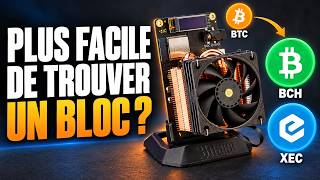
Yes: same SHA-256 chip, same AxeOS, only the pool and the address change. A Bitaxe Gamma at 1.2 TH/s has a 1 in 59 chance a year of finding a Bitcoin Cash block (difficulty of 28 October 2026), against 1 in 16,000 on Bitcoin, for a block worth about 270 times less.
Contents 8 parts and a FAQ · 10 min read
- Can a Bitaxe mine Bitcoin Cash?
- Which Bitcoin Cash address goes in the miner?
- How do I set up a Bitaxe for FindMyBlock Bitcoin Cash?
- Which other solo pools mine Bitcoin Cash?
- What are the odds with the same machine?
- Have small machines already found a Bitcoin Cash block?
- What if your machine finds a Bitcoin Cash block?
- How do I switch back to Bitcoin?
1. Can a Bitaxe mine Bitcoin Cash?
Yes. Bitcoin Cash was born from a split of Bitcoin in 2017 and kept the same mining calculation, SHA-256 The hash calculation Bitcoin uses, and so mining. Bitcoin Cash uses the same one: the same machines mine either.. It is not even the machine that picks the coin: it hashes the blocks the pool A server that machines connect to. A regular pool shares the earnings, a solo pool does not. Solo or pool? sends it, and the pool decides the network. Moving to Bitcoin Cash therefore means switching pool and entering a Bitcoin Cash address instead of your Bitcoin address. Nothing to flash, nothing to buy.
The same goes for every small SHA-256 machine: the Bitaxe, the NerdQAxe++ or the NerdOctaxe, which run AxeOS The open-source Bitaxe software, set from a browser: pool, frequency, voltage, fan. Update it or an interface from the same family, as well as the Avalon Nano 3S, which is set up in the Avalon Family app.
| What matters | Bitcoin | Bitcoin Cash |
|---|---|---|
| The machine, its chip, AxeOS | the same | the same |
| Hashrate Computing power: the number of attempts per second of a machine or of the whole network. The higher it is, the more tickets you play in each draw., power draw, heat, noise | the same | the same |
| The pool | a Bitcoin pool | a Bitcoin Cash pool |
| The address, in the User field | a Bitcoin address (bc1…, 1… or 3…) | a Bitcoin Cash address (bitcoincash:q… or q…) |
| The difficulty How many attempts it takes on average to find a block. It adjusts itself about every two weeks. Difficulty explained | adjusted every 2016 blocks | adjusted at every block |
| What a block pays | about 3.137 BTC including fees, or about €227,000 | 3.125 BCH plus tiny fees, or about €840 |
| Your odds of finding a block | the baseline | about 270 times better |
2. Which Bitcoin Cash address goes in the miner?
You need a Bitcoin Cash address from a wallet whose keys you hold. Bitcoin Cash has its own address format, CashAddr: bitcoincash:q… for a regular address, bitcoincash:p… for a script address. The bitcoincash: prefix is part of the address checksum, and the standard allows it to be left out on display, so many wallets show the address straight away as q…. It is the same address.
Two traps. A Bitcoin bc1… address does not exist on Bitcoin Cash. The old 1… or 3… format, on the other hand, is still valid on both networks: a Bitcoin address starting with 1 would therefore receive your BCH, but on a key managed by a Bitcoin wallet that will not show them. CashAddr exists precisely to avoid that confusion. And as on Bitcoin, never use an exchange address: a block reward arrives through a coinbase transaction, which not every exchange can credit.
Bitcoin Cash wallets where you keep the keys, to download only from their official site:
- Electron Cash (electroncash.org), on Windows, macOS, Linux, Android and iOS. Its site warns that it is the only official site: beware of copies.
- Selene Wallet (selene.cash), on iPhone, Android and in the browser, open source.
- Cashonize (cashonize.com), in the browser or as a Windows, Linux and Android app, open source.
- Paytaca (paytaca.com), on Android, iPhone and as a Chrome extension.
- A hardware wallet: Ledger and Trezor also handle Bitcoin Cash, according to their official pages.
Write the recovery phrase down on paper, then copy the receiving address and check it character by character: it is the one that would receive the block. Hot, cold or hardware wallet: which one to choose.
3. How do I set up a Bitaxe for FindMyBlock Bitcoin Cash?
FindMyBlock Bitcoin Cash is my pool, the Bitcoin Cash sibling of FindMyBlock. Its fee is 1.5%, taken only from a block found (the Bitcoin pool stays at 0%). It is non-custodial: if your machine finds a block, the coinbase transaction sends 98.5% of the reward straight to your address, and the 1.5% fee goes to a separate output of the same transaction.
eu.bch.findmyblock.xyz4335your-bch-address.bitaxe1x- Open AxeOS: type the machine’s IP address in your browser, then open the Pool page from the menu.
- Stratum Host:
eu.bch.findmyblock.xyzon its own, without stratum+tcp:// or the port. Since AxeOS 2.11, if you paste the full address, AxeOS strips the prefix and moves the port into its own box; on an older version, type only the server name. - Stratum Port:
4335, the one for home miners. Port 4338 is for rented hashrate (NiceHash, MiningRigRentals): its share difficulty is fixed, and far too high for a Bitaxe. - User: your Bitcoin Cash address, a dot, then a name for the machine (bitaxe1, bitaxe2…). On this pool, the
bitcoincash:prefix is optional. - Password:
x. - Decode Coinbase Tx: if your AxeOS has this box (since version 2.13), untick it. It displays the addresses the block pays, but in Bitcoin format, and its tooltip says to disable it on non-Bitcoin chains.
- Save, then Restart. After a minute or two, the hashrate shows in AxeOS; on bch.findmyblock.xyz, type your address to see the machine.
Since AxeOS 2.15 (August 2026), the Pool page keeps a list of pools: you can store FindMyBlock Bitcoin and FindMyBlock Bitcoin Cash there and pick the one that mines under “Primary Pool”. The NerdQAxe++ and the NerdOctaxe have the same four fields. On an Avalon Nano 3S, the same details go into the Avalon Family app, where you enter the pool; if it asks for the full server address, it reads stratum+tcp://eu.bch.findmyblock.xyz:4335. The rest of the walkthrough, from Wi-Fi to AxeOS: set up a Bitaxe.
4. Which other solo pools mine Bitcoin Cash?
Two other Bitcoin Cash solo pools, checked on 28 October 2026 on their own pages. The fee matters less than the real question: who receives the block. Either the coinbase transaction pays your address directly and the pool never touches your BCH, or the pool collects the block and pays it out to you afterwards.
| Pool | Fee | Who receives the block | Server for a Bitaxe | Address accepted |
|---|---|---|---|---|
| FindMyBlock Bitcoin Cash (my pool) | 1.5% | your address, directly in the coinbase (98.5%) | eu.bch.findmyblock.xyz, port 4335 | with or without bitcoincash: |
| SoloPool.org | 2% | your address, directly in the coinbase (98%) | eu2.solopool.org, port 8002 | with or without bitcoincash: |
| 2Miners SOLO | 1.5% | the pool, which pays the block out to you afterwards | solo-bch.2miners.com, port 9393 | bitcoincash:… or q… (a 1… address must be converted) |
On SoloPool.org, the user is written the same way as on my pool, your address, a dot and a machine name, with x as the password. Take port 8002, meant for small hardware: its share difficulty, 250K according to the pool, gives a Bitaxe Gamma one accepted share every fifteen minutes or so. The hashrate the pool displays becomes jumpy, but your odds of a block do not change.
On 2Miners, the user is your address and the password x; share difficulty there ranges from 32K to 16M (its help page). The pool keeps the block found, then pays it out to you minus its 1.5%, with payouts every two hours according to its page: convenient, but your BCH pass through the pool. To compare Bitcoin solo pools, fees and custody included: which solo pool to choose.
5. What are the odds with the same machine?
Like Bitcoin, Bitcoin Cash finds a block roughly every ten minutes, but with far fewer machines: about 3.7 EH/s according to its difficulty of 28 October 2026, against about 1,006 EH/s for Bitcoin (network as of 17 October 2026). Its difficulty is therefore about 270 times lower, and the same machine has about 270 times the chance of finding a block.
| Machine | Bitcoin, within a year | Bitcoin Cash, within a year | Bitcoin Cash, within ten years |
|---|---|---|---|
| Bitaxe Gamma (1.2 TH/s rated) | 1 in 16,000 | 1 in 59 | 16% |
| Bitaxe Gamma GT Turbo (2.28 TH/s read in the interface) | 1 in 8,400 | 1 in 31 | 28% |
| NerdQAxe++ Hydro (about 4.8 TH/s rated) | 1 in 3,990 | 1 in 15 | 50% |
| Avalon Nano 3S (6 TH/s rated) | 1 in 3,190 | 1 in 12 | 57% |
| NerdOctaxe (9.6 to 9.7 TH/s measured at the wall) | 1 in 1,980 | 13% | 75% |
Since 15 November 2020, Bitcoin Cash’s difficulty has followed the ASERT rule: it is recalculated at every block, depending on whether the chain runs ahead of or behind the pace of one block every ten minutes, so your odds move from one day to the next when big miners arrive or leave.
The flip side: a Bitcoin Cash block pays 3.125 BCH, about €840 at the price of 28 October 2026, against about €227,000 for a Bitcoin block, or about 270 times less. On average, a machine earns about the same on either: roughly €14 a year for a Bitaxe Gamma on Bitcoin, €14 on Bitcoin Cash after a 1.5% pool fee, before about €32 of electricity a year (18 W rated, at €0.20 per kWh). So Bitcoin Cash does not change the average: it changes the shape of the lottery, with a smaller prize that a home machine can actually reach. And you receive BCH, not bitcoin.
Your Bitcoin odds with your own machine and its electricity: the solo mining calculator. The Bitcoin Cash details, with their own calculator: solo mining Bitcoin Cash.
6. Have small machines already found a Bitcoin Cash block?
Yes, on my pool FindMyBlock Bitcoin Cash: block 970,130, found by a NerdQAxe++ on 25 September 2026, then block 970,943, found by a Bitaxe on 1 October 2026. The pool recognises the machine family from the name its software sends. Every block found by the pool carries the “FindMyBlock BCH” signature in its coinbase transaction, and the explorer shows the reward going to the miner’s address: the proof, block by block.
These blocks change nothing about your machine’s odds: a Bitaxe Gamma still has a 1 in 59 chance a year, and about a 16% chance over ten years. But they show that the Bitcoin Cash prize is within reach of a desk miner, which remains much rarer on Bitcoin (the Bitcoin blocks found solo).
7. What if your machine finds a Bitcoin Cash block?
As on Bitcoin, the reward has to wait 100 blocks before it can be spent: this is the maturity rule, kept in Bitcoin Cash Node’s code. At one block every ten minutes, count on about 16 hours 40 minutes. Count the confirmations on a Bitcoin Cash explorer such as Blockchair, not on mempool.space, which does not cover Bitcoin Cash.
What comes next, the proof to keep and the checks at the exchange where you might sell, works as on Bitcoin: found a block solo, what happens next. On taxes, in France the tax administration classes mining profits as non-commercial profits (BNC), whatever the cryptocurrency (impots.gouv.fr page updated on 17 July 2026). This is general information, not tax advice: with a block at stake, get professional help, and outside France check your own country’s rules.
8. How do I switch back to Bitcoin?
Nothing to reinstall: go back to AxeOS’s Pool page and put the Bitcoin settings back, host eu.findmyblock.xyz, port 3335, your Bitcoin address followed by a dot and the machine name, and x. Tick “Decode Coinbase Tx” again: on Bitcoin, it shows you the address the pool pays. Save, restart, done.
With AxeOS 2.15, if both pools are in the list, simply pick FindMyBlock Bitcoin as “Primary Pool”. Keep in mind that each pool has its own User field: a Bitcoin address for a Bitcoin pool, a Bitcoin Cash address for a Bitcoin Cash pool. The same goes for the “Fallback Pool”: setting up the fallback pool properly.
Bitcoin stays this site’s priority, and FindMyBlock Bitcoin, my pool, stays fee-free: solo mining on FindMyBlock.
Frequently asked questions
Can a Bitaxe mine Bitcoin Cash?
Yes. Bitcoin Cash uses the same calculation as Bitcoin, SHA-256: just enter a Bitcoin Cash pool and a Bitcoin Cash address in AxeOS, without changing anything else on the machine. The same goes for a NerdQAxe++ or an Avalon Nano 3S.
Do I need to type bitcoincash: before the address?
Not on the three pools in this guide (FindMyBlock Bitcoin Cash, which is mine, SoloPool.org and 2Miners): they accept the address with or without that prefix. It is part of the address checksum, and the CashAddr standard allows it to be left out.
Can my Bitcoin address receive Bitcoin Cash?
No. A bc1 address does not exist on Bitcoin Cash, and an old Bitcoin address starting with 1 would receive the BCH on a key managed by your Bitcoin wallet, which would not show them. Create an address in a Bitcoin Cash wallet such as Electron Cash or Selene Wallet.
What are a Bitaxe’s odds on Bitcoin Cash?
About a 1 in 59 chance a year for a Bitaxe Gamma at 1.2 TH/s (difficulty of 28 October 2026), against 1 in 16,000 on Bitcoin (network as of 17 October 2026). But the block is worth that much less, about €840 against about €227,000: on average, the machine does not earn more.
How do I put a Bitaxe back on Bitcoin?
On AxeOS’s Pool page, put back the host and port of a Bitcoin pool (eu.findmyblock.xyz and 3335 for FindMyBlock, my fee-free pool) and your Bitcoin address in the User field, then save and restart. If you had unticked Decode Coinbase Tx, tick it again.
Sources
- The Bitcoin Cash CashAddr address format (reference.cash)
- The ASERT difficulty rule, 15 November 2020 upgrade (Bitcoin Cash Node)
- Bitcoin Cash Node, the 100-block rule (COINBASE_MATURITY)
- AxeOS 2.15.4, the Pool page and the Decode Coinbase Tx option (source code)
- Electron Cash, Bitcoin Cash wallet (official site)
- SoloPool.org, Bitcoin Cash solo pool: fee, servers and ports
- 2Miners SOLO Bitcoin Cash pool: fee, server and payouts
- impots.gouv.fr, mining profits taxed as non-commercial profits (BNC)
A question about this guide? Ask it on the Discord, several of us answer there.
Other guides
-
 Best solo mining pool: Bitcoin and Bitcoin Cash pools compared
Fees, payout and servers of Bitcoin and Bitcoin Cash solo pools, checked and dated.
13 min read · published 28 Oct 2026 · new
-
 Solo mining on FindMyBlock
Understand solo mining, set up your machine and follow your odds.
2 min read · published 23 Sept 2026
-
 Set up a Bitaxe step by step: Wi-Fi, AxeOS and pool
From power-up to the first share: Wi-Fi, AxeOS, every pool field and quick fixes.
10 min read · updated 28 Oct 2026
-
 How long does it take to mine one bitcoin? The math, machine by machine
Centuries in a pool, a lottery solo: the math for each machine reviewed here.
12 min read · published 28 Oct 2026 · new