
Bitcoin mining pool for a Bitaxe: which one pays a small miner?
A shared pool pays your Bitaxe a small slice of every block, instead of the all-or-nothing of solo mining. At that size, fees are not what sets pools apart: the payout threshold is. Depending on the pool, your sats arrive every day, or in several years. Here are the payout schemes in plain words, a comparison of four pools checked on 2 November 2026, the math for a Bitaxe and the settings to type into AxeOS.
Published 2 November 2026, updated 14 November 2026 · by Pixel · 12 min read
 3:45
In a shared pool, a Bitaxe Gamma (1.2 TH/s rated) earns about 56 sats a day on average before fees (network as of 14 November 2026). The payout threshold decides everything: Braiins Pool pays daily over Lightning from 1 sat, while 0.001 BTC at ViaBTC takes about 5.1 years (checked on 2 November 2026).
Contents 8 parts and a FAQ · 12 min read
- What is a shared mining pool, and what does it change for a Bitaxe?
- PPS, FPPS, PPLNS, TIDES: how does a pool pay you?
- How much does a Bitaxe earn in a pool?
- Which mining pool should you choose? The comparison for early November 2026
- Why does the payout threshold matter so much for a small miner?
- Are mining pools too concentrated?
- How do you set up a shared pool in AxeOS?
- So, which mining pool should you choose for a Bitaxe?
1. What is a shared mining pool, and what does it change for a Bitaxe?
A mining pool A server that machines connect to. A regular pool shares the earnings, a solo pool does not. Solo or pool? is a server that hands out work to thousands of machines and relays the blocks they find to the network. In a shared pool, each block reward is split between miners according to the work they did, counted in shares An attempt good enough to be counted by the pool. It proves your machine is working, even if it is not enough to find a block.: attempts that were almost good enough to make a block, which prove your machine is really hashing. In a solo pool it is the other way round: the machine that finds the block keeps it all, and the others get nothing.
On average both pay the same, minus fees: your machine makes the same number of attempts wherever it is pointed. The idea is explained in Solo or pool: which one?, and solo pools have their own comparison, Best solo pool for Bitaxe. This page only covers pools that share.
For a Bitaxe, a shared pool turns a tiny chance at the jackpot (about 1 in 15,300 a year for a Bitaxe Gamma, network as of 14 November 2026; redo it for your machine with the solo mining calculator) into a small, steady income. The catch: that income is so small that the pool’s payout rules matter more than its fee.
2. PPS, FPPS, PPLNS, TIDES: how does a pool pay you?
The payout scheme tells you who carries the luck: you, or the pool.
- PPS (Pay Per Share): the pool pays each share a price set in advance, whether it finds blocks or not. It takes the bad streaks on itself, and charges for that with higher fees.
- FPPS (Full Pay Per Share): PPS that also passes on a share of transaction fees. At Braiins Pool every share is guaranteed a reward, calculated daily on a basis of 144 blocks, with a cut of the block reward and a cut of transaction fees.
- PPS+: a blend. At ViaBTC the block reward is paid PPS-style, and transaction fees PPLNS-style.
- PPLNS Two ways a regular pool shares earnings: by the last shares sent (PPLNS), or a fixed payment per share (PPS). (Pay Per Last N Shares): you only get paid when the pool finds a block, according to your part of its latest shares. Fees are lower, but your earnings follow the pool’s luck: a good week pays more than average, a bad one less.
- TIDES: OCEAN’s variant. Each block found is split according to your part of a share window worth eight times the block’s difficulty How many attempts it takes on average to find a block. It adjusts itself about every two weeks. Difficulty explained; according to OCEAN, that gives a share a 99.9665% chance of being rewarded at least once. The pool builds its blocks to pay miners straight in the coinbase The first transaction of a block, the one that pays the reward. On a solo pool it pays your address directly. transaction whenever possible.
For a Bitaxe Gamma, the difference in average between these schemes is counted in cents: two extra points of fee come to about €0.25 a year (network as of 14 November 2026). What really changes your day to day is when and how the money leaves the pool, and who holds it in the meantime.
3. How much does a Bitaxe earn in a pool?
As of 14 November 2026, the difficulty matches about 965 EH/s for the whole network. A Bitaxe Gamma is about 1 part in 804 million of it, and a shared pool pays it that part of every block, on average:
About 56 sats a day before fees, that is about 20,593 sats and €13 a year. Electricity costs €26 to €32 a year at €0.20 per kWh.
About 454 sats a day before fees, that is about €101 a year, for about €254 of electricity a year at the same rate.
The pool’s fee comes out of these amounts: 2.5% at Braiins Pool leaves a Bitaxe Gamma about 55 sats a day. A pool does not make a Bitaxe profitable, then: it changes the shape of the earnings, not their size. The full math, with the heat put to use in winter, is in How much does a Bitaxe earn? These figures are averages, recalculated at each difficulty adjustment, and they follow the bitcoin price.
4. Which mining pool should you choose? The comparison for early November 2026
| Pool | Scheme and fee | Minimum payout | Lightning | Account | Stratum The language machines and pools speak. |
|---|---|---|---|---|---|
| Braiins Pool | FPPS, 2.5% | Lightning: 1 sat; on-chain: 0.0002 BTC, with a 0.0001 BTC fee below 0.005 BTC | yes, free, daily to a Lightning address | Braiins account, sign-up confirmed by email | stratum.braiins.com:3333 |
| OCEAN | TIDES, 2% (1% with DATUM) | 0.01048576 BTC on-chain, paid in the coinbase | yes, BOLT12, before the threshold | none: your Bitcoin address is the username | mine.ocean.xyz:3334 |
| ViaBTC | PPS+, 4% on the block reward, 2% on transaction fees (PPLNS: 2%) | 0.001 BTC for auto withdrawal | not stated | ViaBTC account | btc.viabtc.io:3333 |
| Kryptex | PPS+, 3% | 0.001 BTC to an address; with a Kryptex account, withdrawals advertised from $1 | with an account, from 0.00001 BTC according to its help page | wallet address or Kryptex account | btc-eu.kryptex.network:7014 |
Braiins Pool. The only one of the four to state a daily payout from 1 sat: over Lightning, free, from 1 sat up to 0.005 BTC per payout, at 9:00 UTC, to a Lightning address (it looks like an email address) set in your account. Until then, your earnings are credited to the financial account created at sign-up: they sit with Braiins until the payout. On-chain, avoid the minimum: a 0.0002 BTC withdrawal pays a 0.0001 BTC fee, half the amount.
OCEAN. No account: your Bitcoin address is the username, and the pool calls itself non-custodial Said of a service that never holds your bitcoin: the reward goes straight to your address., paying miners in the coinbase of its blocks. But the on-chain threshold is 1,048,576 sats, and its terms of service state that until a payout is made, the bitcoin remains OCEAN’s. For a Bitaxe, the only realistic route is Lightning with BOLT12, which OCEAN pays before the threshold (its page gives no minimum). You need a compatible wallet: OCEAN lists Core Lightning, Lexe, Eclair, Coinos (which holds your funds) and Alby Hub 1.21.0 on a fresh install; Phoenix is not compatible yet, nor is Alby Hub from 1.21.2 on (March 2026 warning on that page). You link the BOLT12 offer by signing a message with your Bitcoin address’s key, from Electrum, Sparrow, Ledger, Trezor or Coldcard. Details: OCEAN’s Lightning page. A miner who reported using a NerdQAxe++ did find a block at OCEAN in September 2025: the reward was split between 17 addresses (small miners who found a block).
ViaBTC. The PPS part of the reward is credited hourly to your pool account, but auto withdrawals only go out once a day, between 10:00 and 18:00 (GMT+8), from 0.001 BTC. ViaBTC also ended its solo mode on 20 May 2026.
Kryptex. PPS+ at 3%. Mining to your Bitcoin address, the minimum payout is 0.001 BTC. With a Kryptex account, whose username replaces the address, the pool page advertises withdrawals from $1, in BTC, USDT, via Volet or as gift cards; Kryptex’s help page on withdrawals (30 April 2026) gives the minimum for each method, for example 0.00025 BTC on-chain, 0.00001 BTC over Lightning and $1 via Volet. Your earnings then sit on your Kryptex account until you withdraw: check those minimums in your account before relying on them.
F2Pool and AntPool, two of the three largest pools, are not in this table: I could not check their terms on their own pages on 2 November 2026, and I do not publish fees I have not checked.
5. Why does the payout threshold matter so much for a small miner?
Until you reach the threshold, your earnings stay with the pool. If you switch pools, unplug the machine or the pool changes its rules, what was never paid out may never be. With a small machine, the threshold therefore becomes the first criterion:
| Pool and payout method | Threshold | Bitaxe Gamma (1.2 TH/s rated) | NerdOctaxe (9.6 to 9.7 TH/s at the wall) |
|---|---|---|---|
| Braiins Pool, Lightning | 1 sat | every day | every day |
| Braiins Pool, on-chain | 0.0002 BTC | about 12 months | about 45 days |
| ViaBTC, PPS+ | 0.001 BTC | about 5.1 years | about 8 months |
| Kryptex, to an address | 0.001 BTC | about 5.0 years | about 7 months |
| Kryptex, account, Lightning withdrawal | 0.00001 BTC | about 18 days | about 2 days |
| OCEAN, on-chain | 0.01048576 BTC | about 52 years | about 6.5 years |
| OCEAN, Lightning BOLT12 | no minimum stated | before the threshold | before the threshold |
The verdict is clear: in bitcoin, only Lightning gets a Bitaxe paid within a reasonable time. Without it, a Bitaxe Gamma needs about 12 months at Braiins, about 5.1 years at ViaBTC or at Kryptex to an address, and about 52 years at OCEAN. A stronger machine such as the NerdOctaxe shortens everything, but still does not bring OCEAN’s threshold within reach.
Depending on the wallet, a Lightning address may rely on a service that holds your funds: check it, and sweep your sats now and then to a wallet you hold the keys to (hot or cold wallet).
6. Are mining pools too concentrated?
A pool does not own the machines, but it picks the transactions of every block for all its miners. The bigger it is, the more that choice weighs on the network. Over the month to 2 November 2026 (4,663 blocks), the mempool.space ranking, which attributes each block from the tag in its coinbase, shows:
- Foundry USA: 26.29% of blocks;
- AntPool: 20.42%;
- F2Pool: 16.56%;
- ViaBTC: 9.29%;
- OCEAN: 3.28%, and Braiins Pool: 1.61%.
Three pools found about 63% of the month’s blocks. A Bitaxe will not move that number, but picking a smaller pool points the right way. OCEAN takes the idea further: with DATUM, its software that works with your own node A computer that keeps a full copy of Bitcoin and checks every block itself. Run your own node, the miner builds its own blocks, and the fee drops to 1%. The other way to depend on no big pool is solo mining, on a solo pool or on your own node.
7. How do you set up a shared pool in AxeOS?
In AxeOS, open the Pool page. Four fields are enough:
the pool’s host, without stratum+tcp://the port, in its own fielddepending on the pool, your address or account name, a dot, a machine namex, unless the pool says otherwise| Pool | Stratum Host | Stratum Port | User |
|---|---|---|---|
| Braiins Pool | stratum.braiins.com |
3333 (backup: 443) |
Braiins account name, a dot, a machine name |
| OCEAN | mine.ocean.xyz |
3334 |
Bitcoin address, a dot, a machine name |
| ViaBTC | btc.viabtc.io |
3333 (or 443) |
ViaBTC user ID, a dot, a name in lowercase letters and digits |
| Kryptex | btc-eu.kryptex.network |
7014 |
Bitcoin address, a dot, a machine name |
Mind the difference: at Braiins Pool and ViaBTC the username is your account name, and the payout address is set on the pool’s website; at OCEAN, your Bitcoin address is what gets paid. Braiins notes that the password is not used. The full walkthrough, from Wi-Fi to the first share, is in Bitaxe setup guide.
Set up a second pool too, Pool 2, as Fallback Pool: if the first pool stops answering, AxeOS switches to the second on its own, then comes back. A shared pool as primary and a solo pool as fallback, or the other way round: the combinations that make sense are in Bitaxe fallback pool.
8. So, which mining pool should you choose for a Bitaxe?
- To see sats arrive every day: Braiins Pool over Lightning (FPPS, 2.5%, from 1 sat), with a wallet that gives you a Lightning address.
- No account to create: OCEAN, if you have a compatible BOLT12 wallet. Until the payout, your earnings remain OCEAN’s, as its terms say. On-chain, its threshold is out of reach for a Bitaxe.
- An account on a platform does not bother you: Kryptex, whose account allows Lightning withdrawals from 0.00001 BTC according to its help page. ViaBTC works too, but its 0.001 BTC takes a Bitaxe Gamma years.
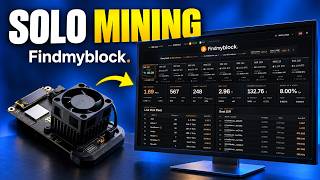
- The jackpot rather than crumbs: a solo pool. Disclosure: FindMyBlock is the solo pool I run (0% fee on Bitcoin); it is not in this comparison because it does not share rewards. Solo pools, mine included, are compared in Best solo pool for Bitaxe.
This comparison is based on the pools’ own pages, not on a payout test. The video for this guide, “7 key steps to choose your crypto mining pool” (in French), dates from June 2023 and covers choosing a pool in general. For fees and thresholds, go by the dated table on this page.
Frequently asked questions
What is the best mining pool for a Bitaxe?
In a shared pool, the one whose threshold you can reach. As of 2 November 2026, Braiins Pool pays daily over Lightning from 1 sat (FPPS, 2.5% fee); OCEAN pays without an account, but only over Lightning BOLT12 at that size. To aim for a whole block, look at solo pools instead.
Does Braiins Pool pay out over Lightning?
Yes: free, from 1 sat up to 0.005 BTC per payout, every day at 9:00 UTC, to a Lightning address set in your account. On-chain, the minimum is 0.0002 BTC, with a 0.0001 BTC fee below 0.005 BTC.
How long does a Bitaxe take to get its first payout?
A Bitaxe Gamma earns about 56 sats a day on average before fees (network as of 14 November 2026). Over Lightning at Braiins Pool it gets paid every day, starting the day after its first full day; it needs about 12 months for 0.0002 BTC on-chain, and about 5.1 years for 0.001 BTC at ViaBTC.
Do you need an account or KYC to mine in a pool?
OCEAN needs no account: your Bitcoin address is the username. Braiins Pool and ViaBTC require an account. None of the pages read on 2 November 2026 mention identity checks for mining; the service that receives your withdrawals may ask for one.
Which mining pool is the most profitable?
None makes a Bitaxe profitable: about €13 a year on average before fees for a Bitaxe Gamma, against €26 to €32 of electricity at €0.20 per kWh. Between a 2% and a 4% fee, the gap is about €0.25 a year; the payout threshold matters far more.
Can you mine in a pool and solo at the same time?
With official AxeOS, a Bitaxe mines on one pool at a time, the second one serving as a fallback. NerdQAxe, NerdOctaxe and NerdQX can split their hashrate between two pools: it is all in the fallback pool guide.
Sources
- Braiins Academy, rewards and payouts: FPPS, 2.5%, Lightning from 1 sat
- Braiins Academy, miner setup: stratum and user ID
- OCEAN, home page and FAQ: fees, payout threshold, no account
- OCEAN, TIDES technical documentation
- OCEAN, Lightning payouts with BOLT12 (14 April 2026)
- ViaBTC, payment methods and fees: PPS+ 4%, PPLNS 2%
- Kryptex, Bitcoin pool: PPS+ 3%, minimum payout 0.001 BTC
- mempool.space, pool ranking by blocks found
A question about this guide? Ask it on the Discord, several of us answer there.
Other guides
-
 Solo or pool: which one?
Same average earnings, two very different ways to receive them.
2 min read · published 23 Sept 2026
-
 Best solo mining pool: Bitcoin and Bitcoin Cash pools compared
Fees, payout and servers of Bitcoin and Bitcoin Cash solo pools, checked and dated.
13 min read · updated 14 Nov 2026 · new
-
 Bitcoin solo mining: the complete guide
Your real odds, the small miners who won, the pool and the settings.
11 min read · updated 14 Nov 2026 · new
-
 How much does a Bitaxe earn?
The honest math: average earnings, electricity and jackpot odds.
2 min read · updated 14 Nov 2026